Notes written with Claude Opus 4.8.
DINO is the first end-to-end Transformer detector to top the COCO leaderboard, but the headline number isn’t the interesting part. The interesting part is what the paper is implicitly arguing: that DETR’s original bet — “don’t hand-design anything, the Hungarian set loss + self-attention will learn duplicate-suppression, localization, and query specialization on its own” — was premature. DINO, together with its parents DN-DETR and DAB-DETR, answers that bet with three surgical interventions, each of which says to the model: you thought you could learn that? Here’s an explicit prior/signal so you don’t have to.
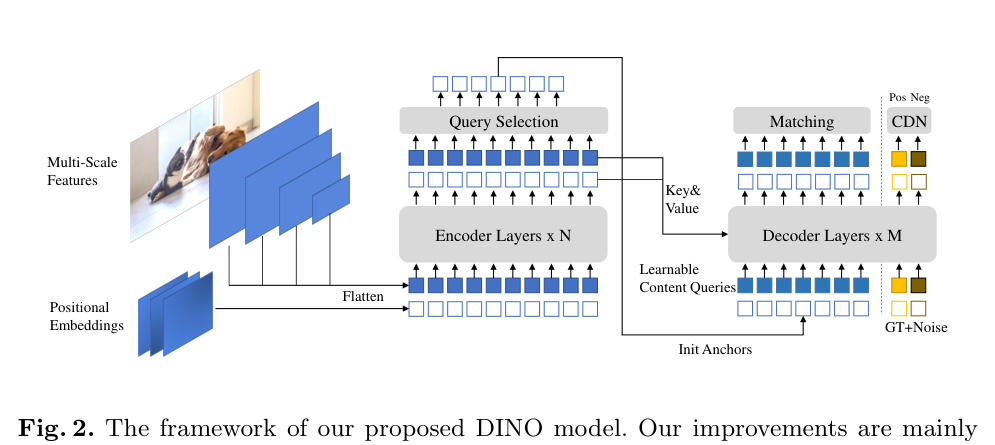
The three contributions are contrastive denoising (CDN), mixed query selection, and look forward twice. Everything else is inherited: DAB-DETR’s 4D anchor-box queries, DN-DETR’s denoising branch, Deformable DETR’s deformable attention + query selection. So the useful way to hold this paper is DAB + DN + Deformable, plus three targeted fixes to things the base loss learns too slowly or too weakly.
The through-line: three kinds of prior, and which survive scale
A recurring question while reading this lineage: as models and data grow, do these tricks become unnecessary — or even harmful? It helps to sort each intervention into one of three buckets, because they have very different shelf lives. This taxonomy is the spine of the note; the synthesis table at the end collects the verdicts.
- Reparameterizations — reshape the optimization landscape without adding information or asserting new structure (DAB’s anchor-box queries; positional/content concatenation). Durable, like RoPE or pre-LN — “helps optimization” doesn’t stop being true at scale.
- Shape priors — assert a specific functional form believed to match reality (DAB’s width/height-modulated attention). Durable only while the assumed form fits; brittle off-distribution.
- Manufactured supervision — inject a training signal because the base loss’s implicit signal is too sparse or noisy (CDN, DN). Most likely to erode with enough clean data — the problem is signal density, not representational capacity.
The problem DETR left underspecified
DETR’s promise was that bipartite matching makes NMS and anchors unnecessary: each GT box is matched to exactly one query (positive), all others are supervised as “no object,” and self-attention lets queries negotiate who owns what. In principle that handles duplicates for free.
Where it’s weak: which query wins a GT box is decided by the Hungarian algorithm at every iteration, from the current predictions. When several anchors sit close to the same object, that assignment is unstable — it flips between iterations on tiny changes in predicted boxes/scores. (This instability is literally why DN-DETR exists; “denoising” names the fact that early-training matching is noisy.) So a runner-up anchor near an object gets inconsistent background supervision: loser this step, maybe winner next. The implicit “back off, this isn’t yours” signal is real but slow and noisy to converge.
DINO’s three ideas each replace a slow/weak emergent signal with an explicit, stable one.
CDN: manufacture the “reject nearby anchor” signal directly
DN-DETR feeds noised GT boxes (noise scale < λ) and asks the model to reconstruct the original — teaching “refine a nearby anchor to its GT.” CDN adds the missing half: a negative signal that teaches rejection.
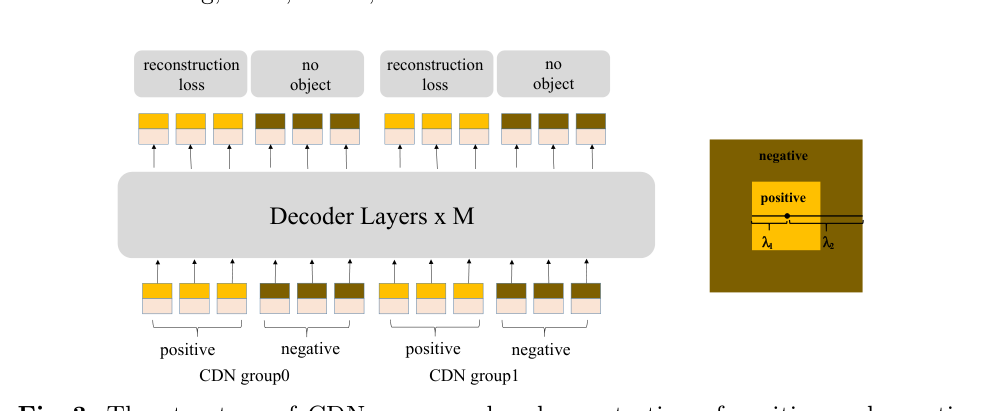
Two concentric squares around each GT box (with λ₁ < λ₂):
- Inside
λ₁(positive): small drift, anchor still clearly owns the object → reconstruct the GT box. - Between
λ₁andλ₂(negative): drifted into ambiguous-ownership territory but not obviously unrelated → predict “no object” rather than snapping back.
Why hard negatives (small
λ₂), and why an egregious negative is uselessThe confusion CDN targets lives only in the local neighborhood of a GT box — that’s where duplicate predictions and “should I claim this?” ambiguity arise. A negative just outside the positive ring sits exactly on that decision boundary, so it sharpens the “close enough to refine” vs. “close but reject” line. A far-away negative is trivially background — the model already handles that as bulk classification. Training on it teaches nothing new and dilutes budget away from the boundary cases that matter. The paper confirms increasing
λ₂(easier negatives on average) doesn’t help. It’s the cat-vs-dog classifier that you “improve” by also showing it a rock labeled “not a dog.”
The mechanism, put plainly: small drift → refine to this object; moderate drift → reject. At inference, when several anchors cluster near a true object, the model has now explicitly learned the split, instead of every nearby anchor greedily claiming the same box and hoping self-attention sorts it out.
Why this beats leaning on Hungarian matching alone
Bipartite matching does try to teach dedup, but it relies on the matcher’s unstable per-iteration decision to supply the “you’re not it” signal. CDN manufactures that supervision deterministically and geometrically — inside
λ₁positive, betweenλ₁/λ₂negative — bypassing the matcher entirely for this lesson. It’s a high-density, stable version of a signal the set loss delivers only slowly. The paper measures this with ATD (Average Top-K Distance): CDN pulls matched anchors closer to their GT boxes, and yields +1.3 AP on small objects over DN alone at 12 epochs.
Mixed query selection: trust position, distrust content
DETR/DN use static queries (learned once, same for every image). Deformable DETR’s query selection goes fully dynamic: both positional and content queries are a linear transform of the top-K encoder features. DINO splits the difference — dynamic positional queries, static (learnable) content queries.
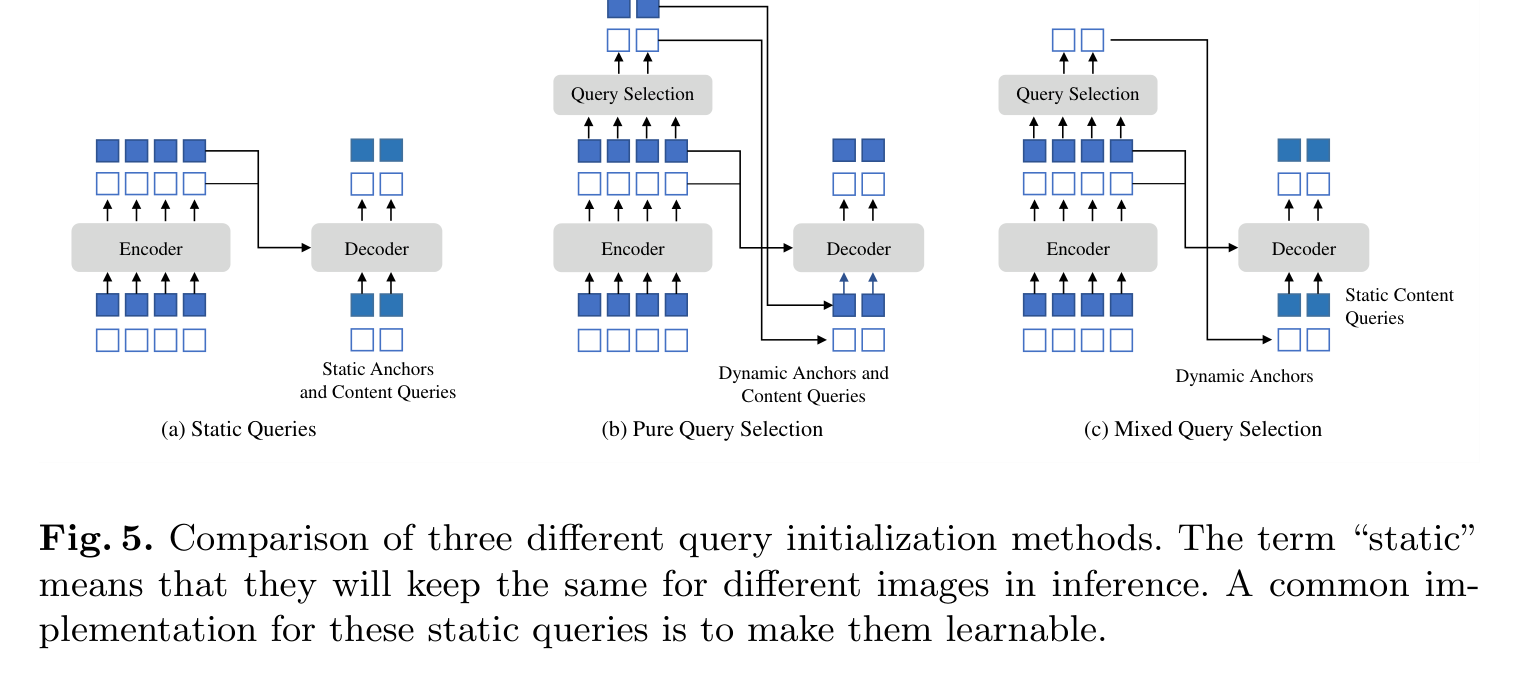
The asymmetry is the whole point. Position from top-K selection is a coarse, robust, low-bandwidth signal (roughly x, y, w, h — “there’s probably something this size here”) that degrades gracefully. Content is a rich, high-dimensional representation the decoder refines over six layers — and the paper’s objection is that a single unrefined top-K feature is “ambiguous and misleading”: it might straddle two overlapping objects or capture only part of one. Initialize content from that and you lock in the ambiguity; every decoder layer then does damage control on a corrupted start. A static learnable content query isn’t tied to any location, so it’s a clean dataset-level default that cross-attention fills in — guided by the trustworthy positional query.
Two subtleties worth keeping
- What does the static content query “look like”? Nobody knows — it’s literally an
nn.Embedding(900, 256)table. No paper in this lineage probes or visualizes it; any specialization is emergent, not designed. Don’t overclaim about it.- Position vs. content refinement isn’t “content can’t be refined.” Both get updated every layer. The real asymmetry: position has an explicit, interpretable update rule (
b'ᵢ = Update(b_{i-1}, Δbᵢ), a geometric op on 4 numbers), so a bad box is correctable. Content has no equivalent — it’s “whatever attention + FFN produce,” with no clean “subtract the wrong object” operation.- The decoder never sees the image — only the encoder’s output memory (keys/values). And DINO’s decoder uses deformable attention: each query samples a few points around its current anchor, not the whole image. So content quality is downstream of position quality every layer: a bad anchor samples the wrong slice of an already-abstracted representation, with no raw-pixel fallback. That’s a stronger argument for “get position right first” than fragility alone.
Is this a fundamental asymmetry, or a "current encoders aren't good enough" gap?
Probably more the latter. The failure mode is a single top-K token being an ambiguous blend near object boundaries. A better encoder (cleaner tokens before selection) or more data (a more robust token→query map) both shrink that ambiguity upstream. The ablation supports “currently worse, not broken”: pure query selection 46.5 vs. mixed 47.0 AP — half a point, the signature of an implementation detail, not a chasm. But unlike ViT-vs-CNN, static content isn’t limiting representational capacity (both feed the same decoder) — it’s a bet about better initialization. So the likely resolution is the gap shrinking toward zero as input ambiguity falls, not dynamic content clearly surpassing static.
Look forward twice: restore a cut gradient path
This one is different in kind from the other two — not manufactured supervision or a prior, but pure gradient-flow engineering, and the most clearly durable of the three.
Deformable DETR refines boxes layer by layer and detaches the box between layers (“look forward once”) to stabilize training — borrowed explicitly from RAFT-style optical-flow refinement. The detach trick itself is old and common (Cascade R-CNN, iterative pose, deep-equilibrium models all reason about where gradients should/shouldn’t flow). What DINO adds — look forward twice — is not cited to any source and reads as a natural next question once you stare at the detach: can we restore some of that signal without the instability that motivated cutting it?
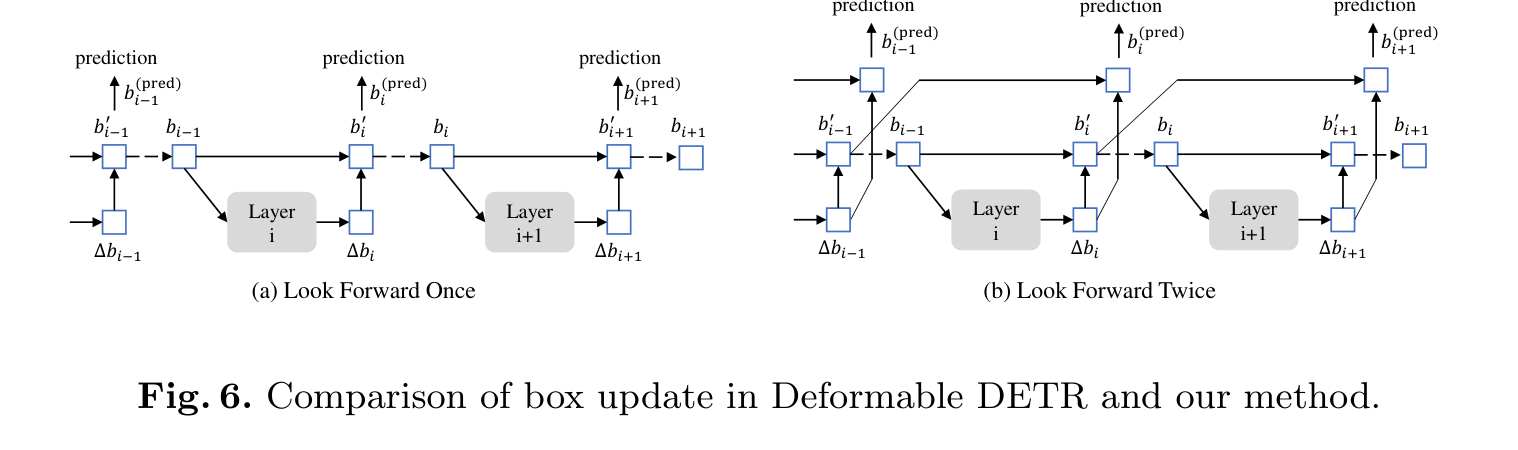
The gap it closes: decoder layers have unshared weights. Under look-forward-once, layer i’s parameters get gradient from exactly one place — its own loss Lᵢ(b'ᵢ, GT). The box it hands downstream is detached, so Lᵢ₊₁ never reaches layer i. Layer i is optimized to be accurate in isolation, but never to be a good handoff — even though “be a good starting point for the next refiner” is precisely what its output is used for.
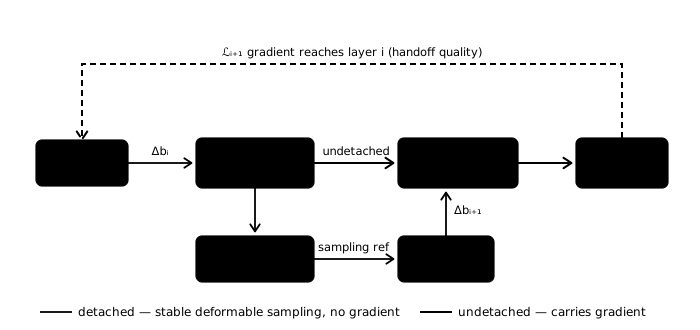
Look forward twice manufactures the missing path: the same offset Δbᵢ is used twice — once to form the detached box bᵢ that seeds the next layer’s deformable sampling (numerically stable), and once through the undetached b'ᵢ that builds the next layer’s prediction. So Lᵢ₊₁ now backpropagates into layer i, while the box actually used for sampling stays detached.
But every layer already has deep supervision — isn't this redundant?
DINO adds auxiliary losses after every decoder layer, so each
b'ᵢalready has its own Hungarian-matched target. The catch: “be accurate” and “be a good handoff” are not the same objective. Two candidate boxes can have identical L1/GIoU loss, yet one sits where deformable attention in the next layer samples cleaner, less-ambiguous features (e.g. avoiding an overlapping neighbor) and the other doesn’t. Direct per-layer loss is blind to this — it only sees distance to a fixed static target, treating each layer as if it produced a final answer in isolation. Only a gradient path running through the downstream consequences of usingb'ᵢcan express “this box led to good refinement.” Look forward twice adds exactly that second, independent signal about handoff quality.
Why cascade refinement at all
Stepping back: why is “6 layers, each emitting a box, each supervised, each refining the last” better than “6 layers, output once at the end”? It is injecting human knowledge — the belief that box localization decomposes into a sequence of corrections through a 4-number geometric bottleneck. But it’s a well-founded prior with a concrete optimization argument, not just intuition.
It's residual learning, applied to boxes
Same story as ResNet. Asking a layer to predict “the box from scratch” is a hard, high-variance regression at every layer; asking it to predict “a small correction to the current guess” is far better-conditioned — the identity/do-nothing default is trivially representable, early layers do coarse localization, later layers do fine. And because the intermediate representation is constrained to be an actual box, the auxiliary loss at each layer has a concrete, interpretable target (“be close to GT”), using the same loss at every depth — you don’t have to invent a proxy loss for an arbitrary hidden state. Dense supervision (GoogLeNet aux heads, stacked hourglass) is an old trick; what’s special here is that the geometric bottleneck makes it natural.
Evidence the constraint earns its keep: dropping to 2 decoder layers costs far more (41.2 AP) than dropping to 2 encoder layers (46.0 AP), both from the 6/6 baseline of 47.4. If decoder depth were interchangeable capacity, they’d hurt comparably — the sharp decoder sensitivity means each layer is a genuinely necessary refinement step.
Which of these survive scale?
Pulling the taxonomy together. Not all “hand-designed priors” age the same way:
| Technique | Bucket | Does it add information? | Verdict under scale |
|---|---|---|---|
| DAB anchor-box queries, pos/content concat | Reparameterization | No — reshapes the loss landscape | Durable (like RoPE / pre-LN) |
| DAB width/height-modulated attention | Shape prior | No — but asserts a functional form | Durable while the form fits; brittle off-distribution (oblique/thin objects) |
| CDN / DN | Manufactured supervision | No — densifies a sparse signal | Most likely to erode — better encoder/more data shrink the ambiguity it compensates for |
| Mixed query (static content) | Safer initialization | No — avoids fragile per-token init | Gap likely shrinks toward 0, unlikely to reverse |
| Look forward twice | Gradient routing | No — restores a cut path | Durable — a compute-graph gap, not a data gap |
| Cascade refinement | Residual + deep supervision | No — better-conditioned landscape | Durable — bigger models still want easy gradients |
The clean precedent for “priors dissolve at scale” is ViT vs. CNN: convolutional locality was a crutch for insufficient data, and JFT-300M dissolved the need for it. But detection hasn’t had its ViT moment — COCO train2017 is ~118K images, tiny by comparison, and even later scaled-up DETR-lineage detectors (Grounding DINO and successors) kept the DN/CDN machinery. So the honest read: the manufactured-supervision tricks are the ones to watch, and the real risk isn’t the principle but the hardcoded knobs (λ₁, λ₂, group counts) tuned to COCO’s object density/scale — those can silently become miscalibrated on a very different distribution (e.g. LiDAR/radar footprints) rather than merely “unnecessary.”
The gains are architecture, not data
Same COCO, big deltas — and SOTA with less data
For the apples-to-apples ResNet-50 comparisons (Tables 1–2), the data is identical to DN/DAB/Deformable DETR — same COCO train2017, no extras. So the +5.6 to +7.5 AP over DN-Deformable-DETR at 12 epochs is 100% architecture + recipe, a clean ablation. For the SOTA result (Table 3), DINO wins with less data than every rival: SwinL (IN-22K-14M) + Objects365 (1.7M) beats SwinV2-G (70M backbone pretrain, ~5×) and Florence (900M image-text, ~60×). The paper’s thesis is explicitly that previous DETR-like models were stuck under 50 AP due to an algorithmic ceiling, not a data ceiling.
Caveat: the paper admits its ResNet-50 numbers rose over v1 due to unenumerated “engineering techniques” — a black-box recipe contribution that isn’t cleanly attributable to the three named ideas (Table 4 tries to isolate this by baselining against an “optimized DN-DETR”).