Note written by Claude (Opus 4.8) from a reading discussion with Sonnet 5.
The one idea
DETR is slow to train because its learnable queries and the way they’re matched to ground truth are unstable early on (DAB-DETR told this story). DN-DETR attacks the matching half with a single trick: alongside the normal learnable queries, feed the decoder a batch of ground-truth boxes with a little noise added, and train it to reconstruct the clean boxes. Since each noised query is built from a specific GT object, its target is known by construction — no matching needed.
The name invites the wrong analogy. This is not diffusion — no timestep schedule, no iterative denoising, and at inference the denoising queries are thrown away (only the matching queries run). The right lineage is the denoising autoencoder: corrupt an input, reconstruct the clean version, use it as an auxiliary signal. DN-DETR is that trick moved from pixel space into query space. Everything else is DAB-DETR unchanged (queries are explicit 4D anchor boxes ), plus a class-label embedding so denoising can cover labels too. One line: DAB-DETR + a denoising-autoencoder auxiliary loss in query space.
The problem it targets: Hungarian matching is unstable
DETR assigns each GT box to one prediction via bipartite (Hungarian) matching. That assignment is dynamic: a small change in the cost matrix can flip which query owns which GT, so a given query gets matched to different objects across epochs — its optimization target keeps jumping. The paper measures this with an instability metric (IS) (how many matches flip epoch-to-epoch) and shows DN-DETR’s IS stays well below DAB-DETR’s throughout early training (Fig. 2). Because a query is a 4D anchor box, a noised GT box is literally “a good anchor near a real object,” and the denoising task hands the decoder a clean, matching-free goal — regress this rough box to that exact GT.
The mechanism
Each decoder query is a 4D anchor box + a class-label embedding. Two kinds of query share the same decoder in one forward pass:
- Matching part — normal DAB-DETR learnable anchors, label = a special “unknown” class embedding. Trained with the usual Hungarian loss.
- Denoising part — for each GT object, corrupt its box (shift center + scale by bounded amounts, ) and its label (flip to a wrong class with prob. ). Target = the original GT box+label; loss = + GIoU + focal, no matching.
At inference the denoising part is dropped. Extra cost is negligible (5 denoising groups: 94.4 → 94.6 training GFLOPs, testing unchanged).
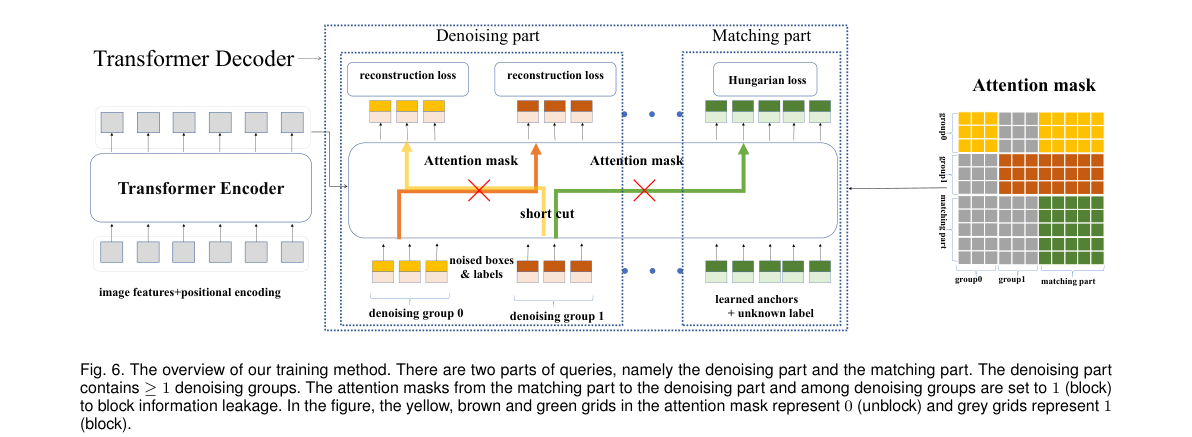
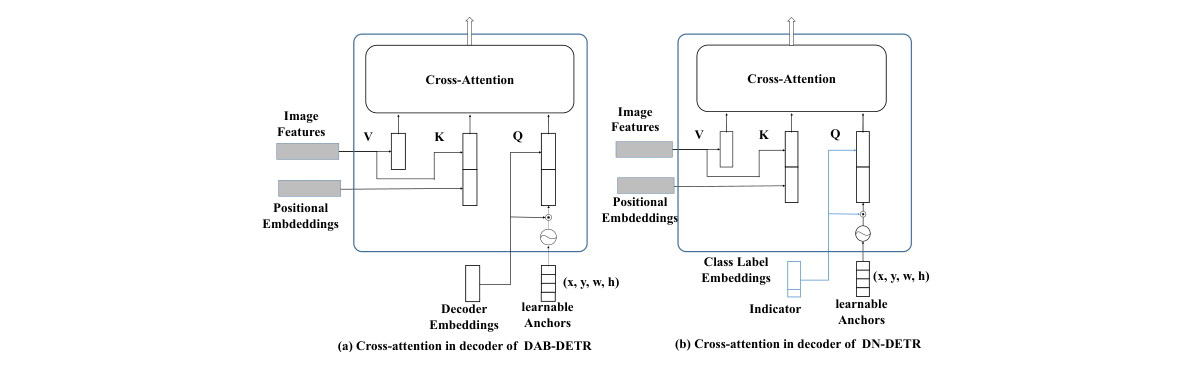
The label embedding is one shared table — there’s no separate space for “denoising” vs “normal” labels. Same class-embedding table (80 COCO classes + one “unknown”), used by both paths, with a 1-bit indicator appended (1 = denoising, 0 = matching) so the decoder — and the attention mask — knows which regime a query is in.
It really is “augmentation → auxiliary output”
The instinct that this is “just augmentation” is correct — it is augmentation plus an auxiliary loss. What makes it more than ordinary augmentation is where the perturbation lands and what it buys: ordinary augmentation perturbs the input image and still routes everything through the hard matching step; DN perturbs the query (the decoder’s “hypothesis”) and gives each perturbed query a known, matching-free target for free, because the query was built from a specific GT box. So the contribution isn’t a new kind of supervision — it’s manufacturing a parallel batch of trivially-correct examples that stress the same shared decoder weights while sidestepping the exact step (matching) causing the instability.
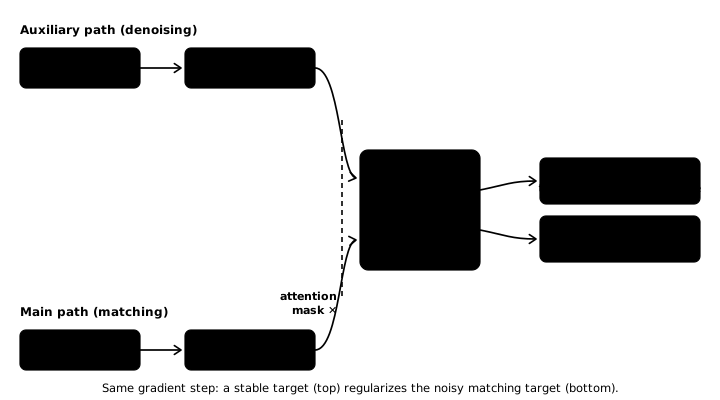
This is a reusable pattern, not a free lunch. The recipe: (1) find a hard combinatorial/assignment step that makes the training signal noisy; (2) build a corrupted-but-labeled version of the intermediate representation whose correspondence to the target is trivial by construction; (3) run both through the same shared weights concurrently, aux path contributing a low-variance loss; (4) mask so the aux signal can’t leak into the main path. Same family: masked language modeling, denoising autoencoders, DINO’s contrastive denoising, teacher forcing. The caveat: it only helps when the bottleneck is an assignment/correspondence ambiguity — if it’s weak features instead, manufacturing an easy correspondence buys nothing.
Why joint training rather than a staged curriculum (pretrain-then-switch)
A tempting alternative: pretrain the decoder on noised-GT queries, then switch on Hungarian matching. The paper doesn’t test it, but joint is the safer default for four reasons: (1) encoder/decoder aren’t separable — cross-attention backprops into the encoder anyway, so “pretraining the decoder” is really a two-phase curriculum on the whole net; (2) distribution shift — a decoder good at “correct a nearby box” hasn’t practiced “search from a bad random init,” and warm-starting can settle into worse geometry; (3) the instability recurs through training (Fig. 2), so bootstrapping just delays it; (4) joint acts like variance reduction — each step mixes a low-variance (denoising) and high-variance (Hungarian) gradient on the same weights, the standard multi-task use of an auxiliary loss.
Fine print
Attention mask is load-bearing, and the results (ephemeral)
Attention mask. Without it, denoising hurts. Two leaks to block: matching queries must not see the denoising part (it carries GT info — they’d cheat), and different noised versions of the same GT object must not see each other. Denoising groups are mutually blocked and hidden from the matching part (block-structured mask in Fig. 6).
Numbers (will age). +1.9 AP over DAB-DETR at the same setting; DN-Deformable-DETR reaches 48.6 AP (R50, multi-scale); comparable AP to the DAB-DETR baseline in ~50% of the epochs. Denoising also plugs into Anchor DETR, vanilla DETR, Faster R-CNN, and segmentation (Mask2Former, Mask DINO) — consistently +1–2.6 AP at 12 epochs, so the trick is architecture-agnostic, not a DAB-DETR quirk.