Note written by Claude (Opus 4.8) from a reading discussion with Sonnet 5.
The one idea
DETR is slow to train, and every prior fix (Deformable DETR, Conditional DETR, SMCA…) attacked the symptom without a clean story for why the learnable queries hurt. DAB-DETR’s contribution is a single reframing: a decoder query should just be a box. Instead of a mysterious high-dimensional learned vector, each query carries explicit 4D anchor coordinates , and the whole point of the paper is that once you commit to that view, three good things fall out for free:
- The positional query becomes an interpretable, sinusoidal encoding of a real box center — the same space the image-feature positions live in.
- The box can be refined layer-by-layer (each decoder layer predicts ), which a high-dimensional query can’t do because there’s no way to map an updated box back to a learned vector.
- The box’s width and height give you a per-object size signal, which DAB-DETR uses to reshape the cross-attention’s spatial prior — its actual novel mechanism (the width/height-modulated attention below).
Everything else is inherited: sinusoidal PE from Attention is all you need, the conditional spatial query from Conditional DETR, the layer-by-layer box update from Deformable DETR. The genuinely new piece is modulating the attention prior with the anchor’s aspect ratio.
Why DETR’s queries were the bottleneck
The paper builds its case by staring at one comparison: encoder self-attention vs. decoder cross-attention. They’re almost the same module — same keys and values (image features) — so whatever slows DETR down must live in the one place they differ: the query.
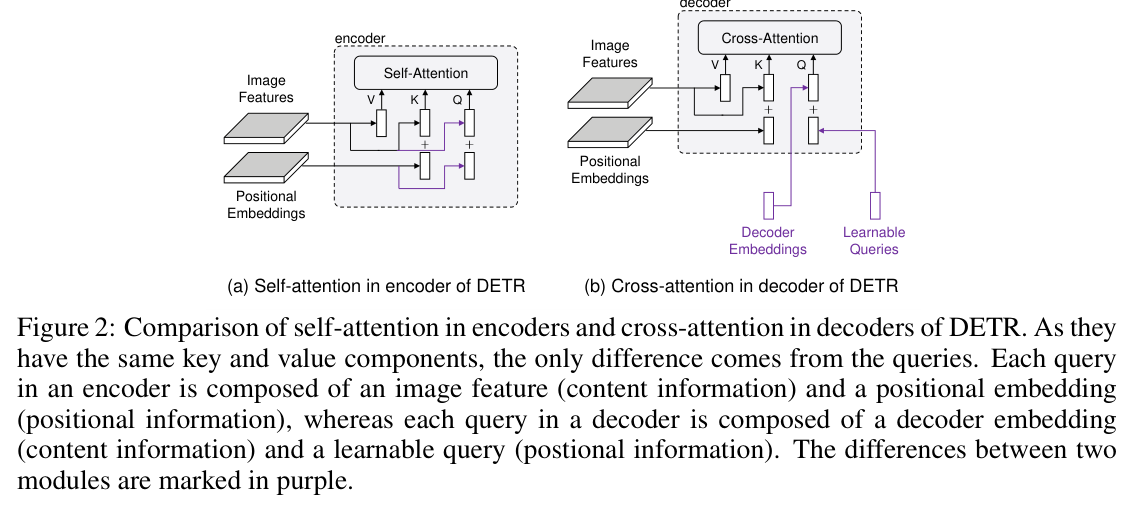
This diagram was the source of real confusion, so worth pinning down the vocabulary it uses loosely:
Two things that are not the same: "decoder embeddings" vs. "learnable queries"
At every decoder layer the query is built from two separate tensors:
- Learnable queries — the “object queries” of vanilla DETR. A fixed learned set (e.g. 100), shared across all images, one per object slot. This is the positional part.
- Decoder embeddings — the content part, initialized to all zeros (
tgt = torch.zeros_like(query_embed)in the DETR code). They start as nothing and only become meaningful after passing through the decoder layers.And the “image features” the diagram feeds into the decoder’s K/V are the encoder’s output (refined feature map after 6 encoder layers), not the raw CNN backbone features. The paper just calls both “image features.”
The argument then runs: because the decoder embedding starts at zero, in layer 1 the query is effectively just the learnable positional query, and the cross-attention output is a weighted sum of image-feature vectors (). So after layer 1 the decoder embedding gets overwritten into the same representation space as image features, and from layer 2 on it behaves just like an encoder feature. The one structural difference that never goes away is the learnable query — a per-slot vector shared across the whole dataset, unlike sinusoidal PE which is computed from actual position. That’s the thing DAB-DETR replaces with a real box.
The reframing: a query is an anchor box
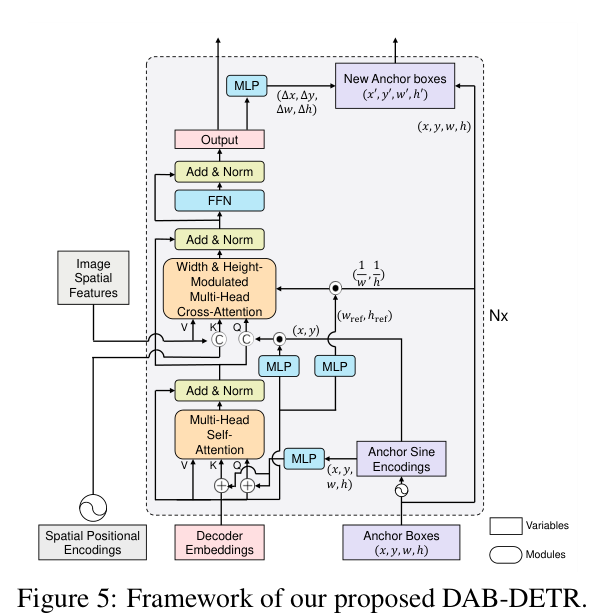
Each query is an anchor with a paired content embedding . The positional query is generated by sinusoidally encoding the box and passing it through a shared MLP:
Because the query is literally coordinates, each decoder layer can predict a relative update and hand a refined box to the next layer (all layers share the update head). This “dynamic anchor” is what the D and A in the name refer to.
Here’s how the query is assembled and where the two positional adjustments act:
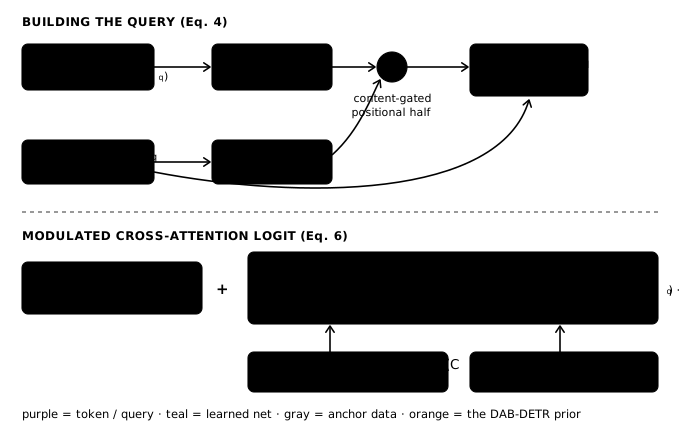
Attention logit = content term + a positional “prior”
The reason the box’s size can reshape attention at all comes from a clean decomposition. Since queries and keys are each , the pre-softmax logit splits into two additive terms:
The positional term depends only on the distance between the query’s anchor center and the key location — it knows nothing about pixels. Plotted over the feature map it’s a smooth bump centered on the anchor, decaying outward.
Why this split is even possible: concat, not add (the load-bearing detail)
This decomposition is not how ordinary attention works, and it’s the quiet reason the whole modulation story is well-defined. Vanilla DETR/transformers add the positional encoding into the content — , — so the dot product expands into four terms: The cross terms entangle content with position, so there’s no isolated “spatial prior” to reshape. DAB-DETR instead concatenates the two halves (Eq. 4 uses ), putting content and position in disjoint dimensions, so the cross terms vanish and the logit is exactly . Only then can you touch the positional term (via the division) without disturbing content matching.
This concat trick is inherited from Conditional DETR, not a DAB-DETR contribution, which is why the paper doesn’t spotlight it — but it’s the foundation the width/height modulation is built on. See Deformable DETR and vanilla DETR for the additive-PE baseline it departs from.
Why the paper calls this a "prior"
Softmax over a sum of logits mirrors Bayes’ rule in log-space: . The positional term is the prior — a content-blind, purely geometric belief about where to look, added before any pixel evidence. The content term is the likelihood. So the whole paper is really an argument about designing a better prior:
- DETR’s learned queries → multi-modal / near-flat prior (bad).
- Conditional DETR → clean single-mode Gaussian, but always the same isotropic size.
- DAB-DETR → per-axis Gaussian whose width matches the object’s actual shape.
The contribution: width & height–modulated attention
This is the paper’s own mechanism. A wide-flat object and a tall-narrow object should pool features over differently-shaped regions, but a single isotropic Gaussian can’t express that. DAB-DETR divides the two positional dot-products by the anchor’s size, independently per axis:
Scaling a logit by a constant before softmax is exactly a temperature: bigger multiplier → sharper attention, smaller → flatter. So:
- Large → small → x-logits shrink → attention spreads wide in x (pool across a wide object).
- Small → ratio large → x-logits amplified → attention sharpens in x (don’t average in background).
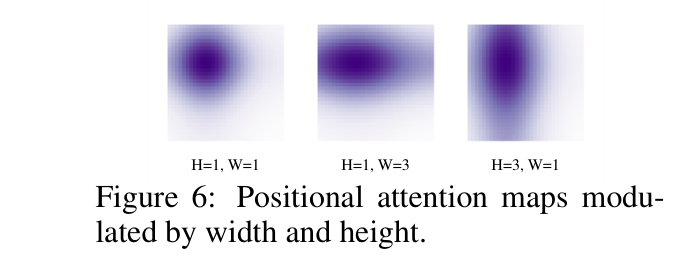
H=1,W=1 is the baseline symmetric bump; H=1,W=3 stretches it wide in x; H=3,W=1 stretches it tall. The per-axis independence is the whole point.
The "ref" notation collides with itself — two unrelated meanings
The section reuses “ref” for two completely different things. This lives entirely in cross-attention (there’s no 2D grid to form a bump over in self-attention).
Symbol What it is Where it comes from a key’s location, swept over the whole feature map encoder output grid this query’s anchor center — the bump’s center from this query’s anchor size (denominator) from a learned calibration scalar, unrelated to position , content only The learned exists (rather than just using ) for two reasons: calibration — the sinusoidal PE dot-product isn’t a literal Gaussian, so there’s no closed-form link between box width and the right amount of sharpening; and numerical safety — a bare blows up as (tiny objects, early training).
Two different "temperatures," stacked
This width/height ratio is a per-query, per-axis temperature. Separately, the sinusoidal PE has a global fixed temperature (=20 in their experiments, Eq. 8) that sets the baseline bump sharpness for everyone. Fig. 7 sweeps from 1 → 10000; larger flattens the prior and helps larger objects. The two compose: sets the base shape, stretches it per query.
Two inherited pieces (not the novelty, but load-bearing)
Conditional spatial query & layer-by-layer anchor update
Conditional spatial query (from Conditional DETR). Before the size-modulation, the positional half of the query is also rescaled by a content-gated vector: . This is a per-channel gain on the PE, computed from content, letting a query amplify the frequency channels relevant to its object boundary (edges/corners) and suppress the rest — turning a generic PE into a query-specific spatial profile. It’s applied only to the encoding, not ; so the positional query is doubly adjusted — content-gated (this) then size-gated (the w/h division). Note this is orthogonal to Deformable DETR’s multi-scale sampling: that mechanism decides where/which resolution to sample; this one only reshapes the dense positional similarity. That orthogonality is exactly why DAB-Deformable-DETR composes cleanly.
Anchor update. Each layer predicts and passes the refined box on (shared head across layers). Only possible because the query is coordinates — you can’t meaningfully update-and-reproject a high-dim learned vector, which is why DETR/Conditional DETR keep their queries static across layers.
Gradient stop between layers (“look forward once”). The refined box is detached before it becomes the next layer’s anchor — literally
reference_points = new_reference_points.detach()intransformer.py. So each layer is supervised (L1 + GIoU aux loss on its own accumulated box, plus a per-layer class head, Hungarian-matched — same as DETR aux losses), but a layer’s box-regression gradient does not chain backward through every earlier layer’s PE computation, which would destabilize training. This is the “iterative box refinement” trick inherited from Deformable DETR; DINO later relaxes it to “look forward twice” (let layer ‘s params also receive gradient from layer ‘s loss), but vanilla DAB-DETR is look-forward-once. Because the accumulated box (anchor + deltas so far) is the thing compared to GT at every layer, you’re supervising the deltas indirectly through the box they produce.Note this delta-supervised box size is a different quantity from the content-derived calibration scalar in the modulation table above: the former is the real, loss-pinned box dimension carried across layers; the latter is , freely learned from content and never directly compared to a GT box — it only sets the per-axis attention temperature.
Where it sits among DETR variants
The appendix’s Figure 8 is the single most useful map of the DETR family — it lays out DETR, Conditional, DAB, Anchor-DETR, Deformable, and DAB-Deformable side by side, marking each model’s difference in purple and its learned high-dim queries in brown. Panel (a) is vanilla DETR; panel (e) is Deformable DETR; the (c) and (f) “Ours” panels show DAB replacing those brown static queries with purple dynamic anchor boxes.
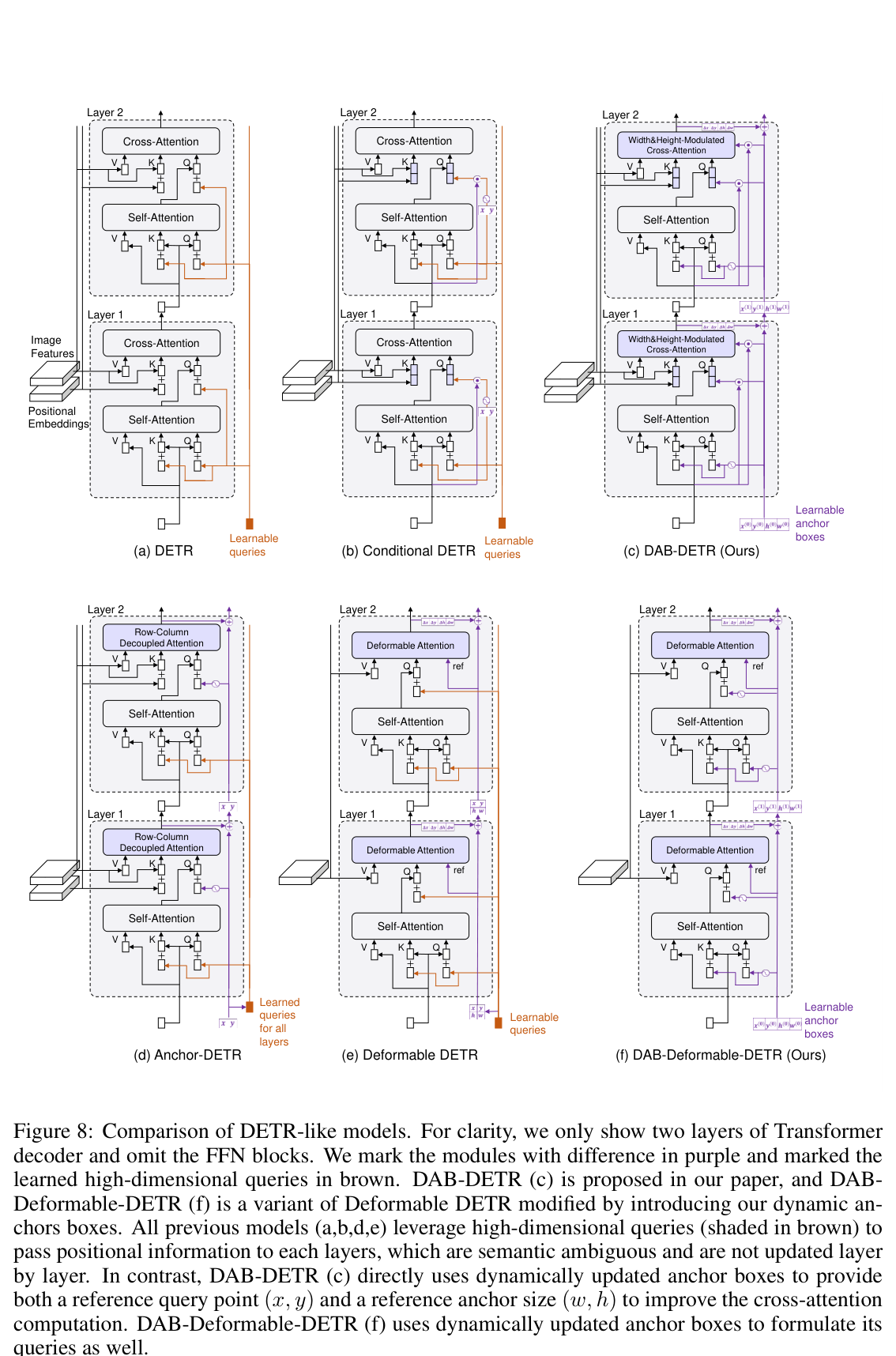
The recurring visual story across (a,b,d,e): high-dimensional queries (brown) that are semantically ambiguous and not updated between layers. DAB-DETR (c) and DAB-Deformable-DETR (f) swap them for anchor boxes that feed both a reference point and a reference size into cross-attention, updated every layer.
What the results lean on (the ephemeral part)
Snapshot numbers — likely superseded
- 45.7 AP on COCO with ResNet-50-DC5, 50 epochs — best among DETR-likes under matched settings at the time.
- DAB-Deformable-DETR: 46.8 AP vs. Deformable DETR+ 45.4 — bolting anchors onto Deformable DETR with “no more than 10 lines of code,” and notably the last-layer loss is lower even though intermediate-layer loss is higher (inference only uses the last layer).
- Decoder-layer ablation: AP climbs 40.2 → 45.7 going 2 → 6 layers; the layer-by-layer anchor refinement is doing real work, not decoration.
- A curious appendix result (Sec. G): fixing at random init (only at layer 1; still updated later) improves AP consistently — conjectured to reduce overfitting.
- Gains depend on the DC5 / multi-scale high-resolution setting; the single-scale variant is weaker on small objects, the usual DETR-family weak spot.