Note written by Claude Opus 4.8 from a discussion with the user.
The task: one segmentation model for all three regimes — semantic, instance, and panoptic — instead of a specialized architecture per task. That’s the “universal” in the title.
The answer is small. Mask2Former = MaskFormer + masked attention. The mask-classification meta-architecture (queries → binary masks by dot product, bipartite matching, a decoupled class head) is inherited wholesale from MaskFormer. The single new idea is masked attention: each query’s cross-attention is restricted to the foreground of its own predicted mask from the previous layer, which fixes DETR-style slow convergence. Everything else — round-robin multi-scale feeding, supervised learnable queries, point-sampled losses — is efficiency engineering, not new concepts. So conceptually this is a short paper: one idea plus a tuned recipe.
Why mask classification (the setup MaskFormer gives us)
Per-pixel classification (label every pixel, group by class) can’t do instances: two adjacent people both get labeled “person” with no boundary to split them on, and connected components fails the moment instances touch or occlude. Box-first methods (Mask R-CNN) get instance separation for free from the box, but the box prior breaks on stuff (sky, road) that has no natural box.
Mask classification predicts binary masks + class labels, matched to ground truth as a set. Instances separate because queries are distinct learned entities; two masks can share a class (that’s instance segmentation) and one mask can cover all the non-contiguous “sky” (that’s semantic). One architecture, all tasks.
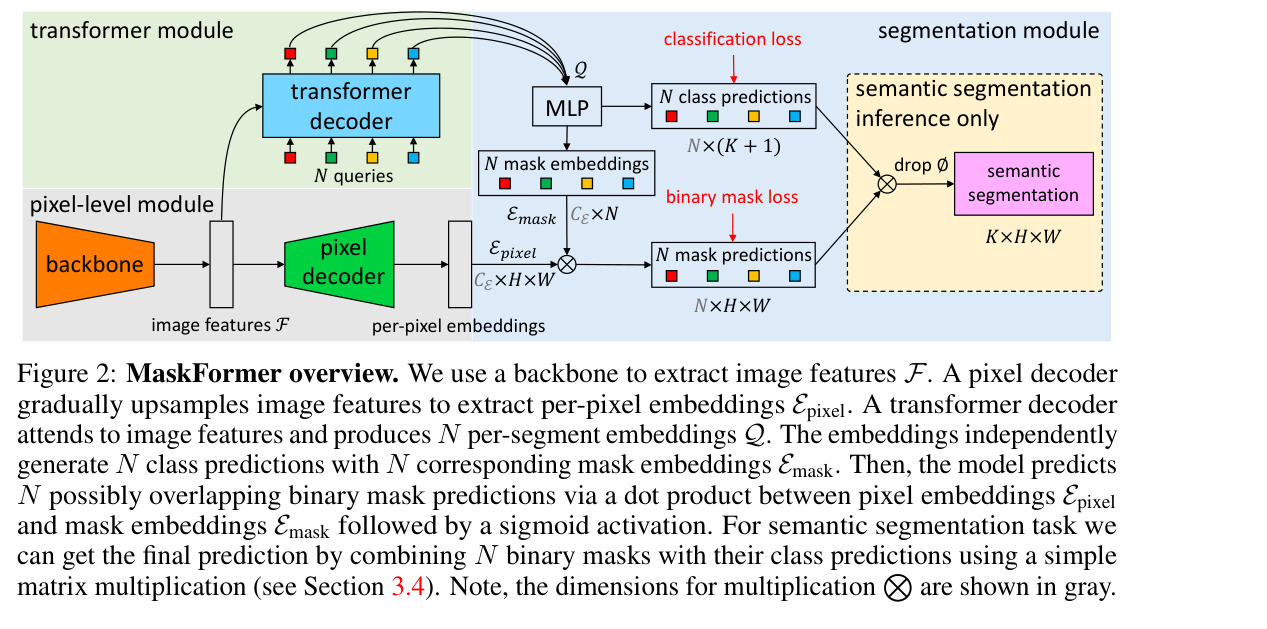
Three components, reused unchanged in Mask2Former:
- Backbone → low-res image features.
- Pixel decoder → gradually upsamples to a per-pixel embedding map .
- Transformer decoder → learned queries cross-attend to image features, producing per-segment embeddings.
How the pixel decoder actually builds the feature maps
Mask2Former’s default pixel decoder is MSDeformAttn (Deformable DETR’s multi-scale deformable-attention encoder), not the plain FPN the original MaskFormer used. Six deformable-attention layers refine the backbone’s 1/8, 1/16, 1/32 maps jointly (these become the round-robin K/V for the decoder); a final FPN-style top-down step — bilinear upsample + lateral 1×1 conv + smoothing conv, no transposed conv — produces the 1/4 map used as . Deformable attention is what makes an encoder over these huge feature maps affordable: each query attends to a few learned sampling offsets, not all tokens. The choice isn’t load-bearing (the meta-architecture is decoder-agnostic; the ablation even finds BiFPN better for instance segmentation) — MSDeformAttn is just the best all-round default.
Each query emits two things from the same vector, via separate heads:
- Class head → a distribution over classes (the is ∅, “no object”).
- Mask embedding head → a -dim vector, dot-producted against every pixel of , then sigmoid → one soft mask.
Sigmoid per mask, not softmax across masks
Masks are predicted independently per query (sigmoid), not normalized to compete across the queries. That’s deliberate — two touching same-class instances need to both confidently claim their own region. An argmax-across-queries only happens at inference, when collapsing to a single flat output; during training the masks don’t compete.
The ∅ class handles variable . You always run a fixed (e.g. 100). Bipartite (Hungarian) matching assigns each of the ground-truth segments to a distinct query; the other go to ∅ and are trained to predict “no object” — classification loss only, no mask loss. The one-to-one constraint is exactly what makes NMS unnecessary: every ground-truth object claims one prediction, redundant detections get pushed to ∅ during training rather than filtered by a post-hoc threshold. The matching cost combines both class and mask terms, so the assignment favors the query already closest in both category and geometry. It’s DETR’s set prediction with mask cost (focal + dice) swapped in for box cost.
Masked attention (the one new idea)
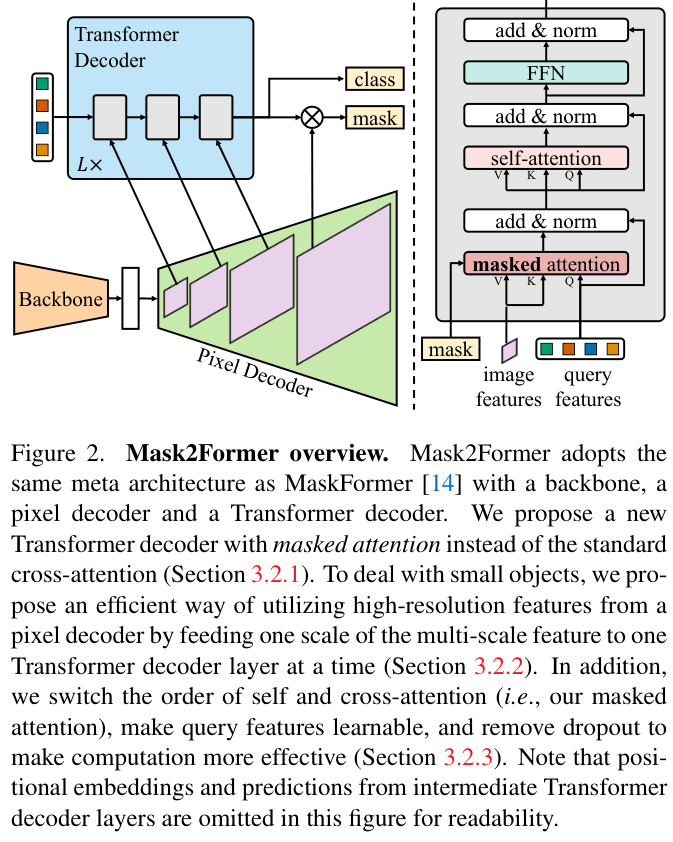
Standard cross-attention lets each query attend to all image tokens. Masked attention adds to the attention logits before softmax: where the previous layer’s mask (binarized at 0.5) is foreground, everywhere else. So each query only gathers image information from inside its own last-layer prediction.
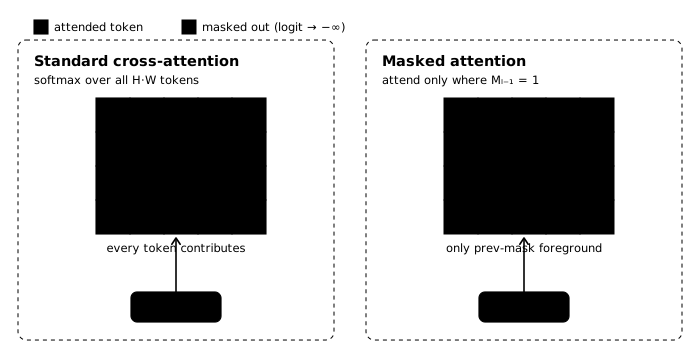
Why it helps — the actual diagnosis. The paper (citing Sun et al.) pins slow DETR-style convergence on the cross-attention softmax: it never quite reaches zero on background tokens, so across thousands of them the aggregate background weight dominates even when each token’s weight is tiny. It takes hundreds of epochs for cross-attention to learn to ignore background on its own. Masked attention just hard-codes that locality from the start. Global context isn’t lost — it still flows through self-attention among the queries; masked attention only constrains where each query reads image features.
Masked attention constrains what a query reads, not what its mask can paint
Easy to misread this as box-cascade refinement (Cascade R-CNN on masks). The distinction that matters: the mask lives only in the cross-attention, which shapes the query vector. Mask prediction is a separate, unmasked step — the query’s mask-embedding vector is dot-producted against every pixel of the fixed map, foreground and background alike; no pixel is excluded there.
So a layer- mask can grow, shift, or change shape relative to layer — it is not forced to be a subset. The constraint is on the query’s information intake, not on where the mask may appear. ( is itself just the previous layer’s ordinary mask prediction, binarized and reused to gate the next layer’s attention.)
Failure mode: if layer badly under-segments, layer ‘s cross-attention is blind to the missing region (only partly rescued by query self-attention) — the thing to watch when porting to sparse/noisy inputs where early masks may be garbage. Mask quality (PQ) does climb monotonically layer 1→9, but “coarse-to-fine” is not a stack-wide property: the feature resolution fed per layer cycles 1/32→1/16→1/8 three times, not once.
Does this hard prior erode at scale? (open)
Hand-coded locality helps most when data/compute are limited — it injects a bias the model would otherwise take many epochs to learn (literally the paper’s own convergence argument). The bitter-lesson worry: at large enough scale it could cap the ceiling, since the model might learn better image-conditioned localization itself. Against that, masked attention doesn’t cut capacity (where masks form is still learned; it only routes information), and later work (Mask DINO, kMaX-DeepLab, OneFormer) kept masked-attention-style constraints rather than dropping them as scale grew — weak evidence it held through ~2023–24 scales. No clean ablation isolates it against pure data scale, so treat this as unresolved.
The efficiency recipe
None of these are conceptual; they’re what make the architecture converge fast, fit in memory, and handle small objects.
Round-robin multi-scale feeding. High-res features help small objects but are expensive. Instead of concatenating all pixel-decoder scales into a long token sequence for every layer (Deformable-DETR style), Mask2Former feeds one scale per layer, cycling 1/32→1/16→1/8 and repeating (3 layers × = 9 total). Each scale gets a sinusoidal positional embedding + a learnable scale-level embedding (both from Deformable DETR).
What the ablation actually says
Naive concatenation is essentially the same accuracy — in fact ~0.3 AP better (44.0 vs 43.7) — but at higher FLOPs (247G vs 226G). So round-robin recovers ~concat accuracy for less compute; it’s not a better representation, and there’s no principled coarse-to-fine curriculum to read into it. The trick is closest in spirit to cascade detectors, not to anything in the DETR line.
Learnable + directly-supervised queries. Two distinct facts:
- X₀ is a static, image-independent learned tensor (like vanilla DETR, learnable instead of zero-init) — not DINO’s per-image query selection, where initial query content is derived from encoder features.
- X₀ is supervised before the decoder: raw X₀ is run through the mask/class heads to get , which receives the standard set-prediction loss before X₀ passes through a single decoder layer.
The ablation is the point: learnable-but-unsupervised queries ≈ zero-init (42.9/51.2/47.0 vs 42.9/51.2/45.5); the direct loss on X₀ is what buys the gain (→43.7/51.9/47.2) and makes X₀ act like an RPN — a decent mask-proposal generator on its own (AR@100 of 50.3 from X₀ alone, rising to 57.7 by layer 9). Plus two minor tweaks: swap self/cross-attention order (X₀ has no image signal for the first self-attention otherwise) and remove dropout (unnecessary, usually hurts).
Point-sampled losses. Full-resolution mask loss is the memory sink (MaskFormer fits one image per 32G GPU). Borrowing PointRend, compute mask loss on () sampled points instead — 18G→6G per image, with no accuracy cost and even a small gain.
Two different samplings, and why
Matching cost uses the same uniform points across all pairs — Hungarian matching compares costs across candidates, so the measuring stick must be shared or the costs aren’t comparable (apples to oranges). Final loss (after matching is fixed, one pair at a time) uses importance sampling: oversample points where the current prediction is ≈0.5, which clusters near boundaries. That’s hard-example mining inside the loss — the same logic as OHEM, but per-pixel-within-a-mask instead of per-RoI. Uniform sampling wastes budget on huge, already-correct flat regions with near-zero gradient; boundary points are where the loss can teach something. Recomputed every step, since “uncertain” is relative to current weights.
Carrying forward
Durable: masked attention as a fix for slow global-softmax cross-attention, and one mask-classification model covering all three tasks. Ephemeral (a 2021–22 snapshot): the 9-layer round-robin decoder, exact point counts, the swap/drop-dropout tweaks, the specific numbers — the parts most likely superseded.
For Mask DINO next: it extends Mask2Former’s mechanism (deformable pixel decoder + query-mask dot-product decoding) grafted onto DINO’s denoising queries, predicting box and mask jointly from the same matched query. MaskFormer is the conceptual seed; Mask2Former is the mechanical baseline it builds on.