Notes written with Claude Opus 4.8.
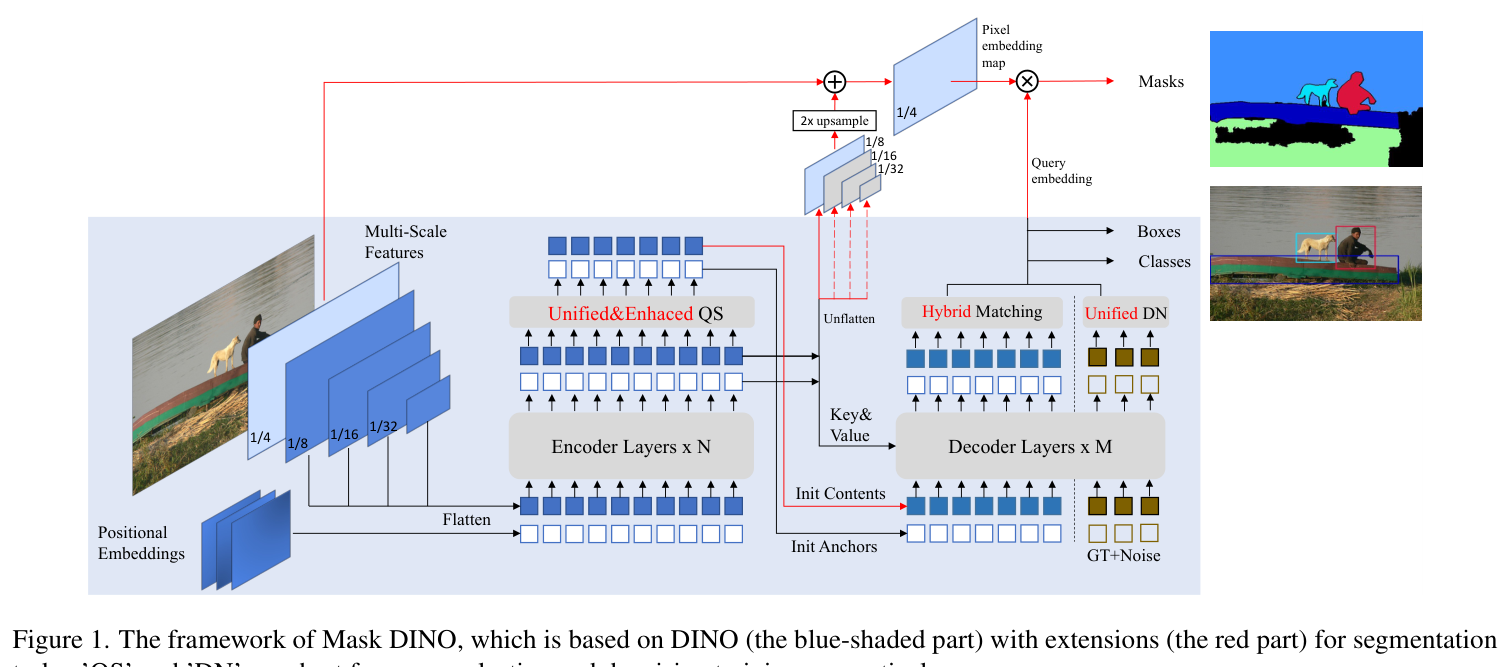
Mask DINO is DINO with a mask branch bolted on — and the paper’s whole argument is that this is not a trivial multi-task add-on but a case where box and mask supervision genuinely reinforce each other, if you let a single set of queries carry both. That’s the central bet. The lineage is unusually clean: take DINO’s detector unchanged (4D anchor queries, deformable attention, query selection, denoising), borrow the mask-classification machinery from Mask2Former (dot-product a content query against a high-res pixel embedding map to get a binary mask), and add a handful of “segmentation micro designs” that make the two tasks cooperate rather than fight.
The framing question the paper opens on is worth holding onto, because it structures everything: prior unified attempts fail in both directions — Mask2Former can’t detect well, DINO can’t segment well (Tables 1–2). Mask DINO’s claim is that a small set of targeted changes to DINO’s shared machinery lets one architecture do both, and even lets detection pre-training help segmentation.
Why neither side could already do both
This is the paper’s motivation, and it’s asymmetric in how convincing it is.
Why Mask2Former can’t detect well — three concrete reasons, which untangle cleanly:
- Its queries were never given a positional prior. They follow vanilla DETR — content queries semantically aligned to encoder features, but positional queries are just single-mode learnable vectors, with none of the anchor-box structure that Conditional/Anchor/DAB-DETR showed matters for boxes.
- Masked attention is a hard constraint. Attention masks from the previous layer are high-resolution and used as hard constraints — efficient for masks, but rigid and ill-suited to box refinement.
- The coarse-to-fine mask refinement doesn’t use multi-scale features per layer.
Point 3 is the soft spot — an assertion riding on the wrong ablation
Mask2Former does use multi-scale features: the round-robin scheme feeds 1/32, 1/16, 1/8 to successive decoder layers. So “fails to use multi-scale features” is imprecise as stated. The defensible version — which the paper never spells out — is that at any single layer Mask2Former sees only one resolution, whereas DINO’s deformable attention samples all scales simultaneously within each layer, conditioned on the anchor box. For box regression, simultaneous multi-scale sampling plausibly matters more than sequential single scales. But Mask2Former’s own ablation (their Table 4d) tested naive multi-scale for segmentation and found it didn’t help — and that result is being used to imply something about detection that was never directly tested. Mask DINO’s own Table 10 actually shows multi-scale helping both tasks (single 1/8 scale → 45.8 box / 45.1 mask; 4 scales → 50.5 / 46.0).
Why DINO can’t segment well — much weaker. The argument is that DINO’s positional queries are anchor boxes and its content queries are trained only to predict box offsets + class, so neither is under any pressure to encode the dense per-pixel similarity structure a mask head needs. Table 2 gives it empirical backing (a DETR head or a Mask2Former head bolted onto DINO both underperform). But it’s stated generically — “these components strengthen region-level representation, which is not optimal for segmentation” — without the mechanistic specificity the Mask2Former critique gets. This is the thinnest justification in the paper.
The core idea: one set of queries, selected dynamically, carrying box + mask
The contribution proper is unified & enhanced query selection. DINO already scores every encoder token with a classification head, takes the top-K by score, and uses their regressed boxes to initialize the decoder’s positional (anchor) queries. Mask DINO extends that same encoder-token prediction stage with a mask head, so the top-K selection now also emits initial masks — and, critically, initializes both the content and the anchor queries from the selected tokens.
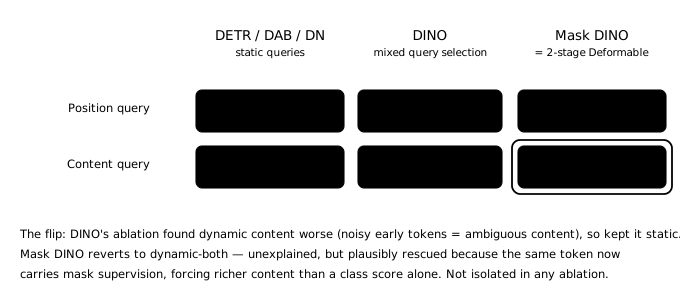
That “both” is the sharp bit, because it reverses a decision DINO deliberately made.
The content-query flip-flop — the paper's most under-explained move
The top-K-by-classification-score mechanism is not from DAB-DETR or DN-DETR (both use static, image-independent learned queries). It enters the lineage with two-stage Deformable DETR, which selects both content and position from the top-K. DINO then asymmetrized it — “mixed query selection,” dynamic position only, content kept static — because its own ablation found fully-dynamic content worse: an early, noisy encoder token can carry ambiguous “what is this” semantics, whereas a fixed learned content vocabulary generalizes better.
Mask DINO reverts to dynamic-both, i.e. exactly the two-stage scheme DINO backed away from — and never addresses the contradiction. My best guess at the implicit rescue: that same token is now also supervised with a mask loss, so producing a good mask forces much richer per-instance content than clearing a classification threshold does, plausibly dissolving the ambiguity DINO worried about. But there’s no ablation isolating this (e.g. unified content selection without mask supervision), so it stays a plausible story, not a demonstrated one.
Mask-enhanced anchor box initialization
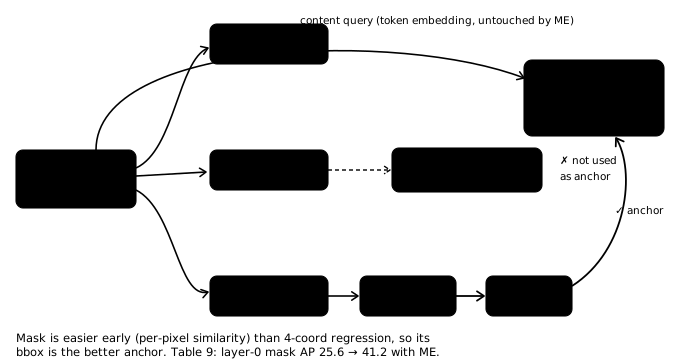
This is the “enhanced” half, and it’s the neatest trick in the paper. The selected top-K tokens run the same three heads as the decoder (class, box, mask). At this early stage box regression is bad (four continuous coordinates is hard) but mask prediction is already decent (per-pixel similarity is a soft task). So instead of feeding the regressed box to the decoder as its initial anchor, Mask DINO takes the predicted mask, hard-thresholds it, and uses the tight bounding box of the foreground as the anchor — a fixed geometric op, not a learned layer (see below). Content initialization is untouched — still the token embedding.
The conversion is engineered and non-differentiable, not a learned layer
In
maskdino_decoder.pyit’smasks_to_boxes(outputs_mask.detach() > 0)(or detectron2’sBitMasks.get_bounding_boxes) →box_xyxy_to_cxcywh→inverse_sigmoidto become the decoder’s reference point. Two consequences worth holding onto:
- Zero robustness in the op. Hard threshold at logit 0 (sigmoid > 0.5), then the raw min/max pixel coordinate of any foreground pixel — no morphology, no connected-component selection, no percentile clipping, no smoothing. One stray positive pixel in a corner blows the box out to include it.
.detach()means no gradient flows through the conversion — it adds no parameters. The only thing “learned” is the mask head (via its own mask loss on the intermediate prediction); cleaner masks → better-derived boxes, indirectly.The lack of outlier handling doesn’t bite because the box is only a seed: it’s refined over M decoder layers (deformable attention + look-forward-twice), so a loose initial anchor gets corrected, and being detached, a bad box can’t corrupt the mask head through gradient. They lean on downstream refinement, not on cleaning the mask.
The Table 9 numbers are counterintuitive — and worth remembering why
Turning ME on at layer 0 barely moves box AP (39.6 → 39.8) but jumps mask AP enormously (25.6 → 41.2). If ME is “just” a box-initialization trick, why does the mask benefit most? Because a tighter, mask-derived anchor also constrains where deformable attention samples in the next layer — and those sample locations feed both branches — so the win compounds downstream in mask quality even though the box itself only nudges. By the final layer the effect is smaller (+1.2 mask AP, layer 9: 50.5 → 51.7). Net effect on the full model: +1.2 box AP, enough to beat DINO by 0.8. The paper never shows a qualitative mask-derived-vs-regressed box on a real image, which is a conspicuous omission given how much this mechanism carries.
Supporting design — the “segmentation micro designs”
The pixel embedding map: why fuse backbone + encoder rather than pick one
The mask branch dot-products each content query against a 1/4-resolution pixel embedding map, built as — the backbone’s 1/4 feature plus the encoder’s 1/8 feature upsampled 2×. The reason it’s a fusion and not just “use the encoder output” is structural: DINO’s deformable encoder never runs at 1/4 resolution (too many tokens), so is the only source of that resolution, while is the only source of global/contextualized semantics. It’s a one-hop FPN-style skip — the cheap reuse of Mask2Former’s pixel-decoder idea, since the deformable encoder is already there. Not ablated against alternatives (Cb-only, heavier fusion) in this paper.
Hybrid matching — the one most easily mistaken for “just adding three losses.” The novelty is in the matching step, not the loss step. Box and mask heads are only loosely coupled, so matching on box cost alone can assign query i to the object its box overlaps best even when its mask looks like a different object — and you’d then train the mask head against the wrong target. Hybrid matching folds class + box + mask into a single cost matrix for one Hungarian solve, forcing pairings that are good on all three at once.
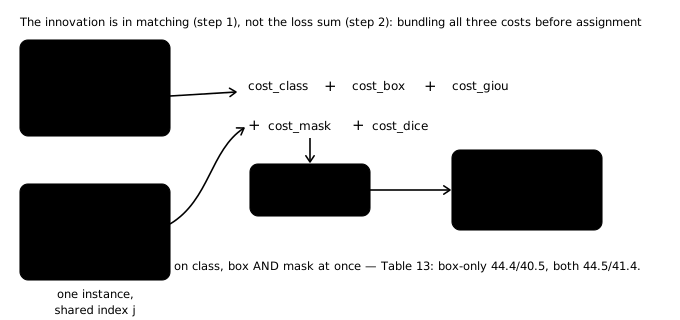
I confirmed this against the official matcher.py: targets["labels"/"boxes"/"masks"] are three parallel tensors indexed by a shared instance index; pred_logits/pred_boxes/pred_masks are three heads off the same query. Every cost term (cost_class, cost_bbox, cost_giou, cost_mask, cost_dice) is a full [queries × targets] matrix, all summed into one C fed to a single linear_sum_assignment. Table 13 is the payoff: matching by box only → 44.4 box / 40.5 mask; by mask only → 40.2 / 38.4; by both → 44.5 / 41.4, better on both simultaneously (not a compromise), which only makes sense if the fix is in assignment.
Decoupled box prediction (panoptic). For “stuff” categories (sky, grass) a bounding box is degenerate — often the whole image. So Mask DINO drops box loss and box matching cost for stuff, while keeping mask + class. The box pipeline still runs for stuff (its box steers deformable attention), it just isn’t graded. In matcher.py this is literally cost_bbox[:, ~isthing] = cost_bbox[:, isthing].mean() — neutralized to a filler value, not zeroed (a 0 would attract the solver toward stuff-matches). Not COCO-specific in principle; validated only on COCO panoptic (Table 14).
Unified denoising for masks. Reuse DINO’s box-noise machinery but ask for a mask too — treating the coarse box as a “noised version” of the fine mask, so no new noise operator is needed. See the gap below on what actually ships.
Where the paper is thin (some of it confirmed in code)
Open questions and paper-vs-code gaps
- The “C” in CDN is missing from the released code. The paper frames “unified denoising” against a joint DN-DETR + DINO citation, implying it inherits DINO’s contrastive denoising (the positive/negative two-ring split where moderate-noise queries learn to predict “no object”). It doesn’t.
maskdino_decoder.py’sprepare_for_dnis self-documented as “modified from dn-detr,” uses a singlenoise_scale(0.4) and singledn_num(100), and trains every noised query to reconstruct — there is no negative/reject group, nopos_idx/neg_idx. A repo-wide grep forcdn/contrastivereturns nothing. So relative to DINO’s own denoising this is a regression, not an extension — plain single-tier DN, now also emitting a mask target. (Theλ1/λ2in Appendix B.2 are center-shift vs scale magnitude — a notation collision with DINO’s two-ring radii, not the same thing.)- Unablated design choices. The Cb+Ce pixel-embedding fusion is never compared against Cb-only or a heavier fusion. The dynamic-content revival is never isolated from its mask supervision, so we can’t tell whether mask loss is what rescues it (see the flip-flop callout).
- Missing qualitative evidence. No figure showing the mask-derived box vs the regressed box on a real image, despite ME carrying +1.2 AP.
- The DINO-can’t-segment argument stays generic where the Mask2Former-can’t-detect argument is concrete.
- Augmentation, for the record, matches the paper and is unremarkable: LSJ (resize ∈ [0.1×, 2.0×] then fixed 1024² crop) + flip, the mapper literally reused from Mask2Former. No photometric augmentation.
On the "no new SOTA" limitation — it's a training-memory story, not what the paper implies
The paper attributes not reaching detection SOTA to GPU memory forcing smaller images / fewer queries. The real bottleneck is per-sample activation memory: the mask branch’s
queries × H/4 × W/4intermediate scales with resolution and query count, and that’s a single-sample compute-graph cost, not a parameter-storage one. So the instinct to “just shard the model” targets the wrong axis (sharding/tensor-parallel spread parameters), and quantization/pruning are inference tools that don’t touch training-time activations. They already did the obvious thing — 4 → 16 A100s — but that’s data parallelism (IMS_PER_BATCH: 16on 16 GPUs = 1 image/GPU), which does nothing for the per-sample ceiling; there’s no smaller micro-batch to accumulate into either, so gradient accumulation is also inapplicable. The one tool that does fit — gradient checkpointing (recompute activations in backward, mature since ~2020) — is absent from the repo (grepfinds notorch.utils.checkpoint). They did enable AMP and use Mask2Former’s point-sampled mask loss, so they weren’t naive about memory — they stopped one standard tool short. (Tensor-parallelizing the mask branch’s spatial/query dim is possible in principle but not something Megatron ships off-the-shelf for this architecture shape.) Reads as scoped engineering effort, not a hard wall.
What it’s built from, in one line
DINO (detector, unchanged) + Mask2Former’s mask-classification head, glued by: unified dynamic query selection (from two-stage Deformable DETR), mask-enhanced anchor init (new), hybrid joint matching, decoupled stuff boxes, and mask-extended (single-tier) denoising.