This can be seen as a direct successor of the vanilla MoE, applying this to OG Transformer with tweaks on loss.
There’s also a GShard paper in between, which according to Mixture of Experts Explained, introduces the two new idea:
- Random routing: in a top-2 setup, we always pick the top expert, but the second expert is picked with probability proportional to its weight.
- Expert capacity: we can set a threshold of how many tokens can be processed by one expert. If both experts are at capacity, the token is considered overflowed, and it’s sent to the next layer via residual connections (or dropped entirely in other projects). This concept will become one of the most important concepts for MoEs. Why is expert capacity needed? Since all tensor shapes are statically determined at compilation time, but we cannot know how many tokens will go to each expert ahead of time, we need to fix the capacity factor.
Now back to this one. Only the FFN is being converted to MoE layer. This is the same as GShard.
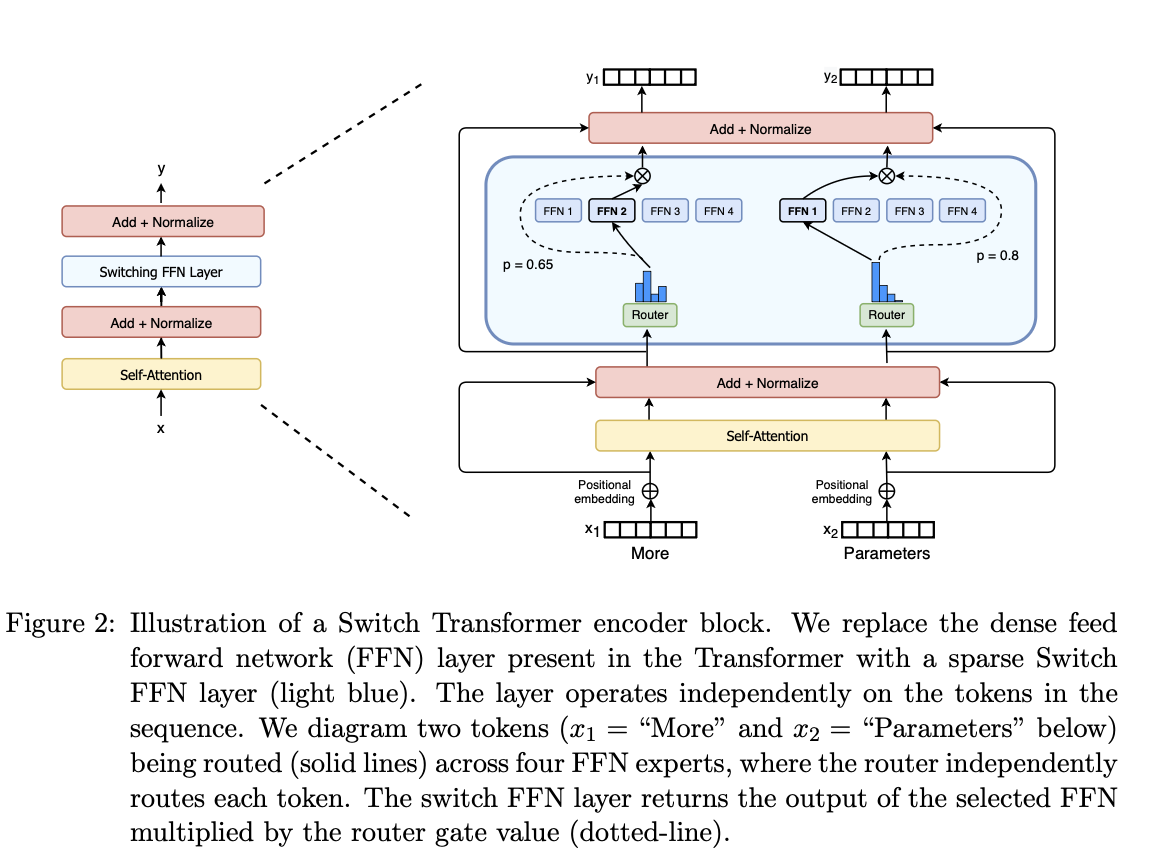
Single expert
Recall in the vanilla MoE, k experts are picked and the results are added together. Here the author argue a single expert is enough.That’s where the name “switch” comes from. The reaons
- Routing computation is reduced
- Batch size can be at least halved
- Routing implementation is simplified and communication costs are reduced. In summary, all because of infra. This is a pragmatic paper.
Efficient Sparse Routing
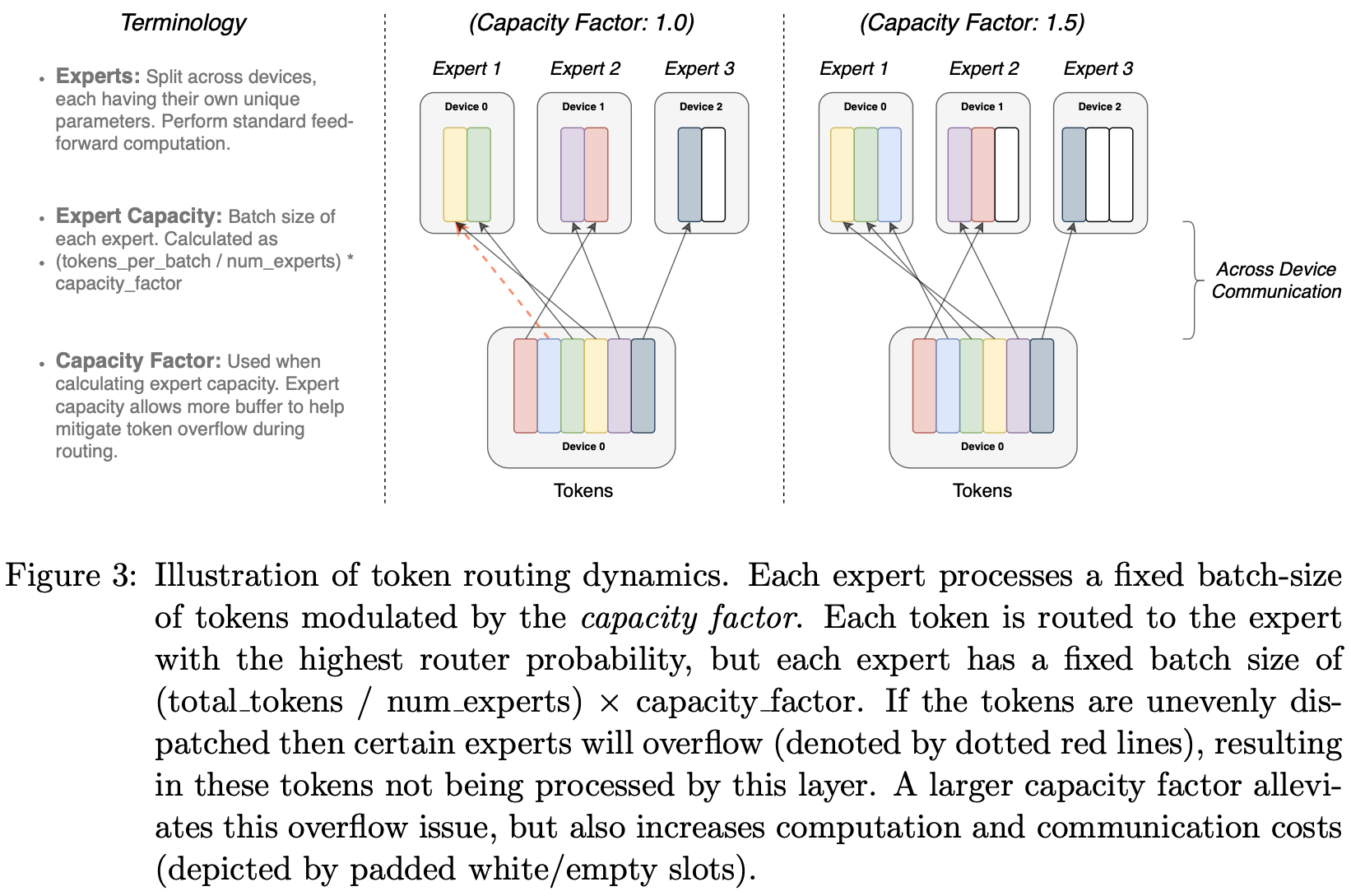
If too many tokens are routed to an expert (referred to later as dropped tokens), computation is skipped and the token representation is passed directly to the next layer through the residual connection.
switch_transformers, page 7 Later in the experiment they show that
Switch Transformers perform better at lower capacity factors (1.0, 1.25). Smaller expert capacities are indicative of the scenario in the large model regime where model memory is very scarce and the capacity factor will want to be made as small as possible
What they thought would make it better but didn’t
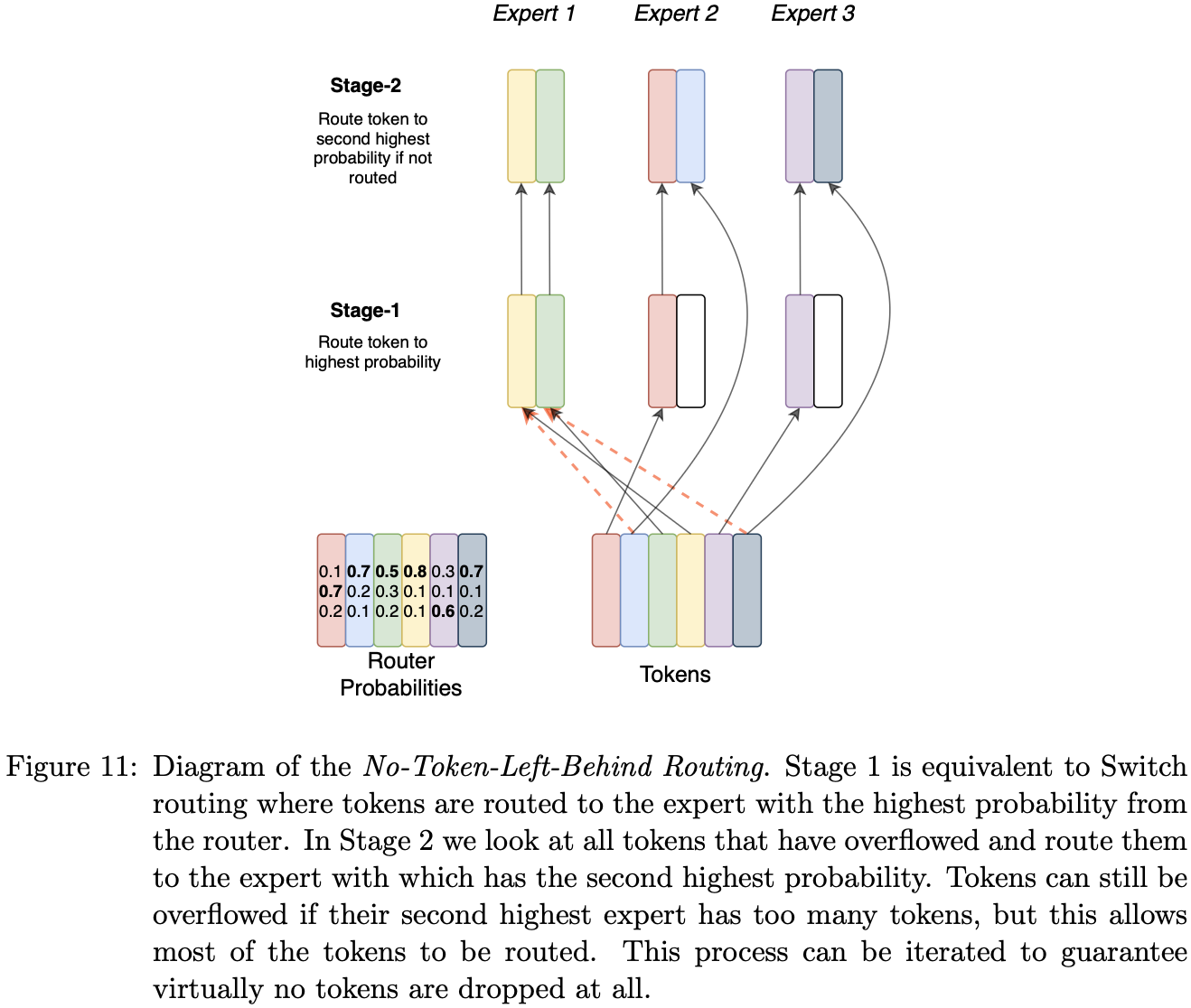
We hypothesised that this could improve performance and further stabilize training, but we found no empirical benefits. We suspect that once the network learns associations between different tokens and experts, if this association is changed (e.g. sending a token to its second highest expert) then performance could be degraded.
New load balancing loss
Switch Transformers simplifies the original design in Shazeer et al. (2017) which had separate load-balancing and importance-weighting losses.
Given experts indexed by to and a batch with tokens, the loss is calculated as follows:
Key Definitions:
- : The fraction of tokens dispatched to expert .
- : The fraction of the router probability allocated for expert .
- Objective: The loss is minimized when both and have values of , encouraging a uniform distribution.
The objective can also be differentiated as -vector is differentiable, but the -vector is not.
throughout this work we use an which was sufficiently large to ensure load balancing while small enough to not to overwhelm the primary cross-entropy objective.
Make it stabler
- Selective precision: use fp32 within router and bf16 in other parts. Make sure only bf16 is in all-to-all operations.
- Smaller parameter initialization:
We initialize our weight matrices by drawing elements from a truncated normal distribution with mean and standard deviation where s is a scale hyper-parameter and n is the number of input units in the weight tensor (e.g. fan-in) As an additional remedy to the instability, we recommend reducing the default Transformer initialization scale s = 1.0 by a factor of 10.
Dropout when fine tuning
They pretrain on a large corpus followed by fine-tuning on smaller downstream tasks. Smaller dataset leads to overfitting.
We thus propose a simple way to alleviate this issue during fine-tuning: increase the dropout inside the experts, which we name as expert dropout. During fine-tuning we simply increase the dropout rate by a significant amount only at the interim feed-forward computation at each expert layer.
However, setting a smaller dropout rate (0.1) at non-expert layers and a much larger dropout rate (0.4) at expert layers leads to performance improvements on four smaller downstream tasks
It trains fast
Our Switch-Base 64 expert model achieves the same performance of the T5-Base model at step 60k at step 450k, which is a 7.5x speedup in terms of step time.
Later they got 7x training time speed up too. This basically means the communication cost is not high.
Distillation
They tried distilling to a dense model with the same FLOP matched dense model. So inference speed is the same, but model size much smaller.
| Technique | Parameters | Quality (↑) |
|---|---|---|
| T5-Base | 223M | -1.636 |
| Switch-Base | 3,800M | -1.444 |
| Distillation | 223M | (3%) -1.631 |
| + Init. non-expert weights from teacher | 223M | (20%) -1.598 |
| + 0.75 mix of hard and soft loss | 223M | (29%) -1.580 |
| Initialization Baseline (no distillation) | ||
| Init. non-expert weights from teacher | 223M | -1.639 |
Parallelism
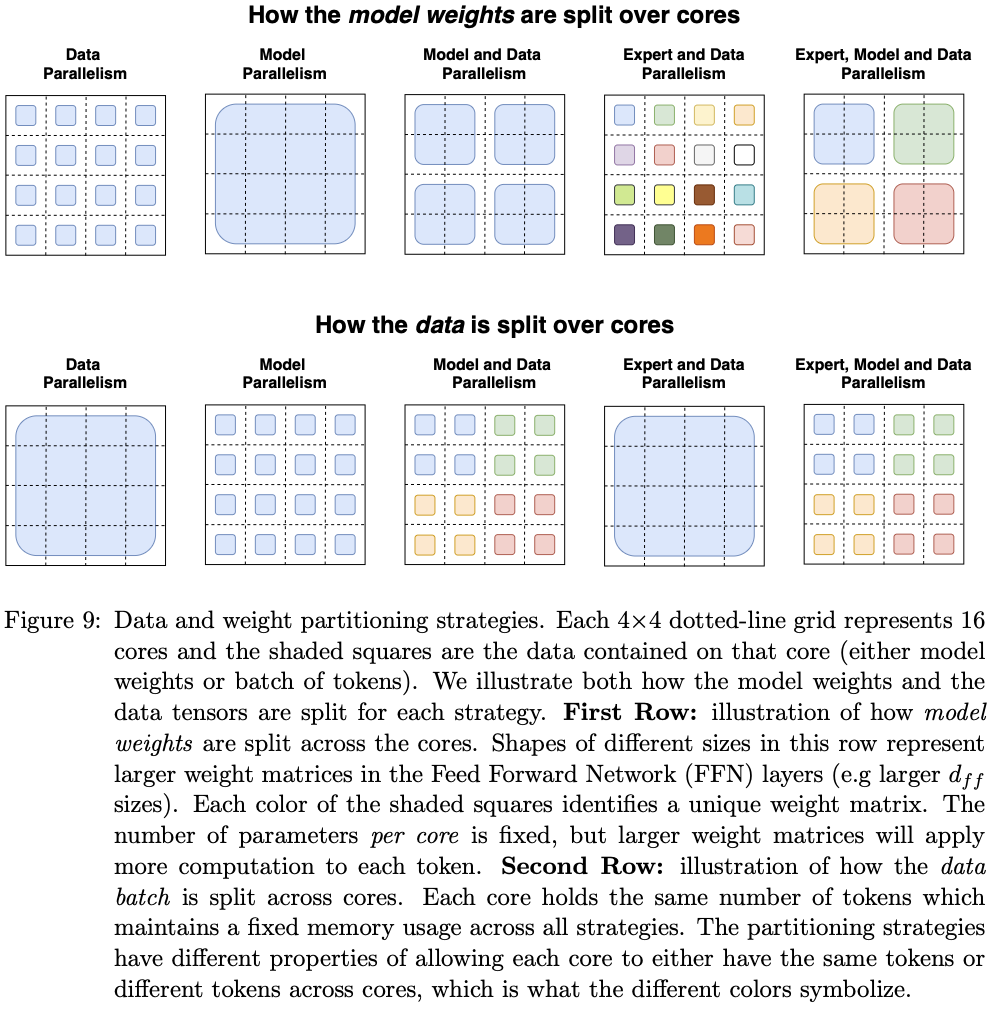
This is before the time that we have tensor parallelism, pipeline parallelism etc., back when the model and the infra improvement can be in the same paper.
For the “model parallelism” here, they are splitting the FFN layer between devices. They tuned how do balance the splitting.
Limitations
The training is not stable for large models.
While our stability techniques were effective for our Switch-Base, Switch-Large and Switch-C models (no observed instability), they were not sufficient for Switch-XXL.
As a result, though this is our better model on a step-basis, we do not pre-train for a full 1M steps, in-line with the final reported results of T5
Downstream tasks may have worse performance
Generally we find that improved pre-training quality leads to better downstream results (Appendix E), though we sometimes encounter striking anomalies.
We note that while the SwitchXXL has state-of-the-art Neg. Log Perp. on the upstream pre-training task, its gains have not yet fully translated to SOTA downstream performance.
This warrants future investigation and study to fully realize the potential of sparse models. Understanding the fine-tuning dynamics with expert-models is very complicated and is dependent on regularization, load-balancing, and fine-tuning hyper-parameters.
Apply MoE to self attention leads to training instabilities.
In Appendix A, we report quality improvement adding these inside Self-Attention layers, where our layer replaces the weight matrices which produce Q, K, V. However, due to training instabilities with the bfloat16 format, we instead leave this as an area for future work.