One and half a year later, again from Kaiming.
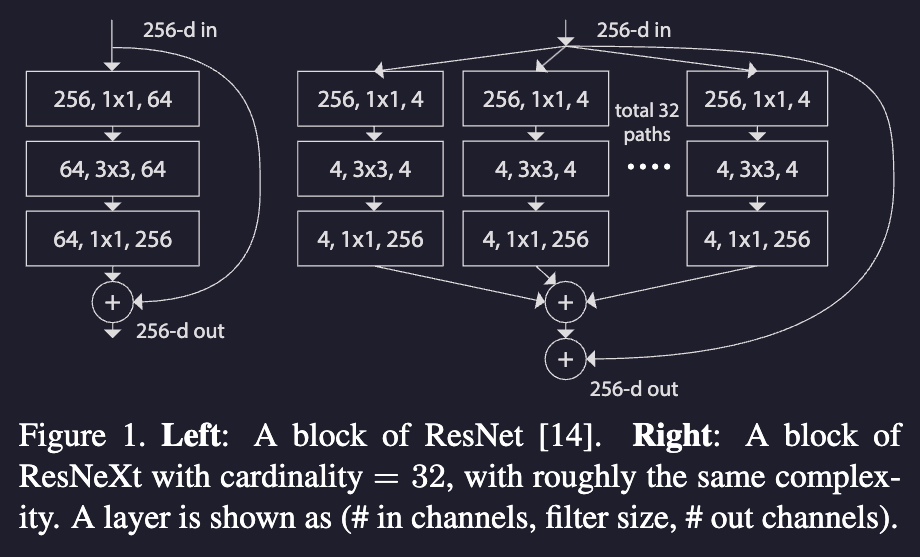
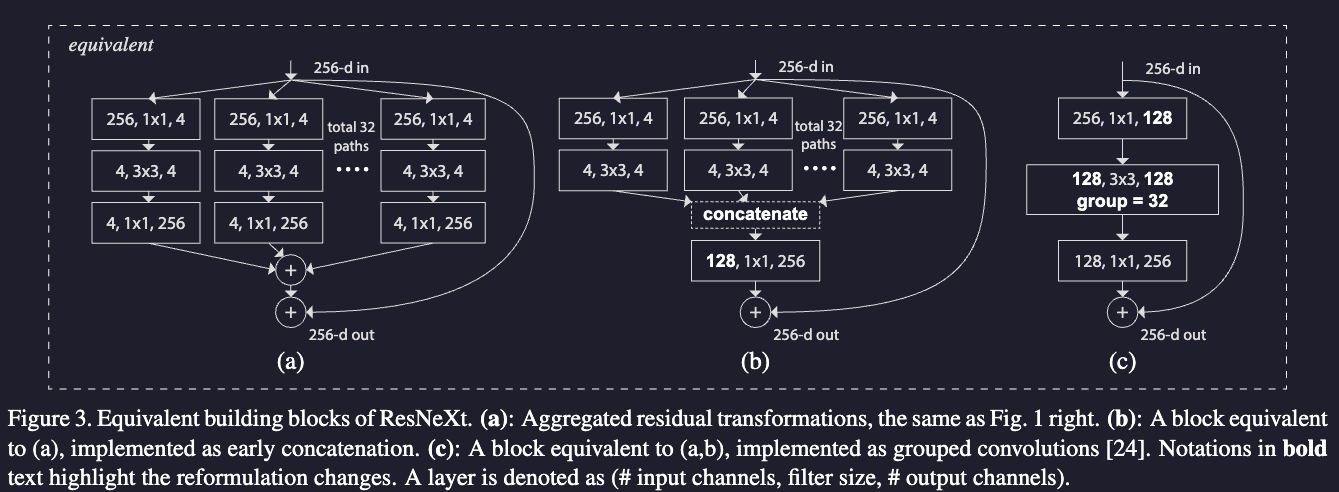 Here the team takes a note at Inception’s slit-transform-merge strategy, and combine it with VGG or ResNet’s simple structure. By doing so, with same FLOPs and parameter count, we got better performance. Note that this doesn’t mean network runs at the same speed though.
Our method indicates that cardinality (the size of the set of transformations) is a concrete, measurable dimen- sion that is of central importance, in addition to the dimen- sions of width and depth. Experiments demonstrate that in- creasing cardinality is a more effective way of gaining accu- racy than going deeper or wider, especially when depth and width starts to give diminishing returns for existing models.
Note there’s something in the paper that I don’t understand:
We note that the reformulations produce nontrivial topologies only when the block has depth ≥3. If the block has depth = 2 (e.g., the basic block in [14]), the reformula- tions lead to trivially a wide, dense module. See the illus- tration in Fig. 4.
In the Experiments section, they explained that increasing cardinality (more groups) is better than going deeper or wider.