Notes written with Claude Opus 4.8 from a discussion of the paper.
EgoScale (NVIDIA GEAR, built on the GR00T N1 backbone) makes one bet: human-to-robot transfer for dexterous manipulation is fundamentally a scaling problem, and a human hand is just another embodiment. If you pick an action representation that humans and robots can share, you can pretrain a VLA on ~20k hours of noisy, in-the-wild egocentric human video, and that noisy prior beats small amounts of clean, perfectly-aligned robot data. The method itself is deliberately plain — almost everything interesting is in what they chose to supervise and what the ablations justify, which is how I’d read the paper: it’s a sequence of “why this, not that” decisions.
The one design choice everything rests on: a shared action space
The whole thing only works because human demos and robot demos are expressed in the same action space. That space has two halves, and each half is a deliberate trick.
Arm = relative wrist motion in SE(3). Instead of absolute end-effector pose, they predict relative wrist transforms within an action chunk, ΔWᵗ = (W⁰_w)⁻¹ Wᵗ_w (each pose expressed relative to the chunk’s first frame). This is the same move as Universal Manipulation Interface — make the trajectory relative so the absolute camera/base pose drops out.
Same trick, slightly different payoff than UMI
UMI uses a relative end-effector trajectory so a handheld gripper’s data transfers to a robot regardless of mounting. EgoScale uses it so that noisy in-the-wild SLAM egomotion doesn’t poison the arm signal — the camera is on a person’s head moving unpredictably, and a relative formulation makes that egomotion cancel out. Same idea (relativity buys invariance), different thing being cancelled.
Hand = 21 human keypoints retargeted to 22-DoF joint angles. This is the part that distinguishes dexterous transfer from the gripper-based human-data line of work. Two sub-decisions worth keeping:
- They retarget at all because the target hand is anthropomorphic. The robot uses a 22-DoF Sharpa hand whose kinematics resemble a human hand, so a per-keypoint → per-joint mapping is meaningful. A parallel-jaw gripper has nothing to map fingers onto; that’s precisely why gripper-based human-data methods can’t do fine articulation. The human-shaped hand is what lets them keep finger detail instead of collapsing to a wrist pose.
- Retargeting is solver-based, not a learned net (App. D): a per-frame nonlinear program over the 22 joint angles, subject to URDF joint limits, solved with CasADi/IPOPT, warm-started from the previous frame, exp-smoothed for temporal jitter. Deterministic, optimization-in-the-loop — they trust the geometry rather than learning the map.
For human data there’s no proprioceptive state, so they substitute a learnable placeholder token where the robot’s state input would go — a small thing, but it’s what lets one model ingest both human and robot data without architectural forks.
The two ablations that actually carry the paper
Read §3 as two “why” questions. Each is settled by an ablation, and the two are about different axes.
Why this training strategy? (Fig 4) — scale-of-noisy beats precision-of-aligned
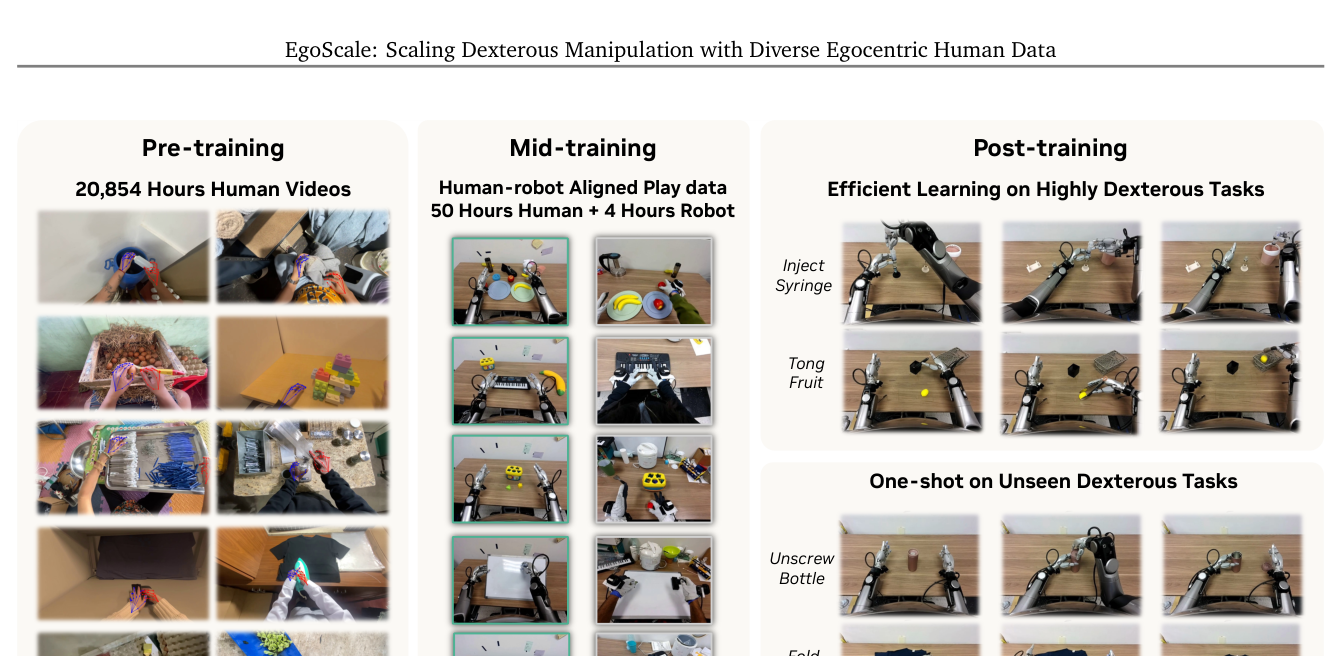
Four checkpoints, five dexterous tasks (shirt-roll, card-sort, tong-transfer, bottle-cap, syringe). The numbers that matter (avg completion / success):
| Recipe | Completion | Success |
|---|---|---|
| No pretrain | 0.24 | 0.02 |
| Midtrain only (clean, aligned human+robot) | 0.53 | 0.28 |
| Human pretrain only (noisy, in-the-wild) | 0.71 | 0.38 |
| Human pretrain + midtrain | 0.83 | 0.56 |
The headline isn’t “the recipe works” — it’s the ordering. Noisy, unaligned, in-the-wild human pretraining alone beats the clean, perfectly-aligned human–robot mid-training baseline. Scale-and-diversity of messy data outweighs precision of aligned data. Then only ~4 hours of aligned robot data in mid-training is enough to cash the prior out to the top row. The mid-training stage’s job is narrow: ground the already-learned manipulation structure into the robot’s sensing/control space, not teach manipulation.
The three stages, concretely
- Stage I — pretrain. 20,854 h egocentric human video. Mostly proprietary in-the-wild recordings (9,869 scenes, 6,015 tasks, 43,237 objects) labeled by off-the-shelf SLAM + hand-pose pipelines; plus the named 829 h EgoDex slice (Apple Vision Pro, accurate tracking). Supervised on relative wrist + 22-DoF retargeted joints. Full model unfrozen.
- Stage II — aligned mid-training. 344 tabletop tasks, ~30 human + ~5 robot trajectories each (~50 h human, only ~4 h robot). Same camera rig as the robot; wrist via Vive trackers, hand via Manus gloves (25 joint transforms). VLM backbone frozen.
- Stage III — post-training. Vanilla task fine-tune, 100 teleop demos/task (20 for shirt-roll). This is standard; the paper’s claim is the Stage I+II pairing, not this.
Why this action space? (Fig 8) — supervise the joints, not just the wrist
Holding everything else fixed, they swap what the human action is during pretraining: wrist-only vs fingertip-based vs full retargeted joints (completion score):
| Task | Wrist-only | Fingertip | Retargeted joints |
|---|---|---|---|
| Card | 0.56 | 0.17 | 0.74 |
| Tong | 0.24 | 0.76 | 0.79 |
| Bottle | 0.26 | 0.55 | 0.61 |
Wrist-only collapses on contact-timing tasks (grasps too weak, closes too early) — it never sees finger articulation. Fingertip helps but is inconsistent: small fingertip-pose errors map to implausible joint configs after IK. Retargeted joint-space is the most consistent. This is a concrete claim about what to supervise for dexterity, and it’s the strongest “they learned something non-obvious” result in the paper.
Cross-embodiment: the payoff of treating a hand as an embodiment (Fig 7)
If the human prior is really an embodiment-agnostic motor prior, it should transfer to a robot it was never shaped for. They test on the Unitree G1 — shorter arm, different workspace, and a 7-DoF tri-finger hand, versus the 22-DoF Sharpa it pretrained in.
Mechanism is lightweight (and the paper is thin here — they don’t say much): the VLM backbone, relative-wrist prediction, and DiT action expert stay shared; only small embodiment-conditioned MLP adapters at the input (proprioception in) and output (joint actions out) are swapped per embodiment. Add a little G1 play data to mid-training and the human-pretrained policy beats a G1-only baseline (Pen-in-Bin 0.83 vs 0.45; Dish-in-Rack 0.88 vs 0.54). Crucially the G1 is never trained from scratch — mid-training only re-aligns an existing human-derived prior to a new body. That’s the cleanest evidence for the “human = reusable embodiment” thesis.
The scaling law (treat as suggestive, not a law)
At 1k–20k h, the offline human-action validation loss (MSE on held-out wrist+hand actions) follows a clean log-linear fit, L = 0.024 − 0.003·ln(D), R² = 0.9983, and downstream completion rises monotonically 0.30 → 0.71 with no saturation. The genuinely useful nested claim is that offline val-loss tracks real-robot performance — i.e. you could predict whether scaling is paying off without running expensive robot evals.
Read the scaling claim with the fine print
- The fit is 5 points, 2 parameters — R²=0.9983 is close to vacuous as a “law.” And the loss only moves 0.024 → 0.015 across a 20× data increase; the offline–online correlation rides on the same 5 points.
- “One-shot” is one robot demo plus 100 aligned human demos per task, not a single demonstration total.
- Internal inconsistency on Fold Shirt: p2 says mid-training “contains only folding behaviors,” p9 says Fold Shirt does not appear in mid-training. Likely a wording slip, but it muddies how much of the 88% is generalization vs near-distribution recall.
- Reproducibility ≈ 0: the bulk ~20k h corpus is proprietary and unnamed (only the 829 h EgoDex slice is named), and the upstream hand-pose estimator + SLAM are just “off-the-shelf.” The retargeting is fully disclosed (App. D); the data and labeler are not.
Implementation snapshot
Ephemeral details (GR00T N1-inherited; likely to be superseded)
Flow-matching VLA: VLM encodes image + language instruction → DiT action expert predicts an action chunk via flow matching. Embodiment-specific MLP adapters for state-in/action-out; backbone + wrist head + DiT shared across embodiments. Training: Stage I 100k steps on 256 GB200, batch 8192, lr 5e-5, full unfreeze → Stage II 50k steps, batch 2048, VLM frozen → Stage III 10k steps, batch 512. Robot: Galaxea R1Pro, bimanual 7-DoF arms in relative EE space, 22-DoF Sharpa Wave hands, head + two wrist RGB cameras.