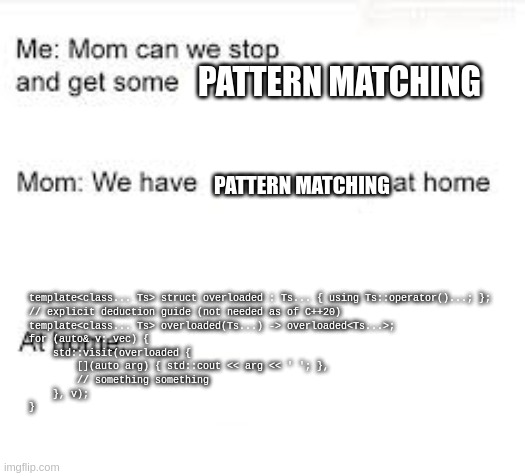
Enum is not the enum in C++ or Enum in Python. If it has to be state in the
term of C++, it’s like a combination of std::variant + class enum +
std::tuple. To state in other word, enums contains variants of types that can
holds other data.
but the data stored can not be retrieved trivially, like:
let m = Message::Move(6, 9);println!(m.x);
would not compile. This is because the type of m is Message, not a
custom type. To get the data out you’ll need some match.
Another example of pattern matching
#[derive(Debug)]enum UsState { Alabama, Alaska, // --snip--}enum Coin { Penny, Nickel, Dime, Quarter(UsState),}fn value_in_cents(coin: Coin) -> u8 { match coin { Coin::Penny => 1, Coin::Nickel => 5, Coin::Dime => 10, Coin::Quarter(state) => { println!("State quarter from {:?}!", state); 25 } // (1) }}fn main() { value_in_cents(Coin::Quarter(UsState::Alaska)); // Showcase the usage of if let let coin = Coin::Penny; let mut count = 0; if let Coin::Quarter(state) = coin { println!("State quarter from {:?}!", state); } else { count += 1; }}
matches are exhaustive. You can use others => foo(others) or _ => 42 to
handle the default cases.
The Option enum
The Option in stdlib looks like this:
enum Option<T> { None, Some(T),}// Use like thisfn main() { let some_number = Some(5); let some_string = Some("a string"); let absent_number: Option<i32> = None;}}